
Overview
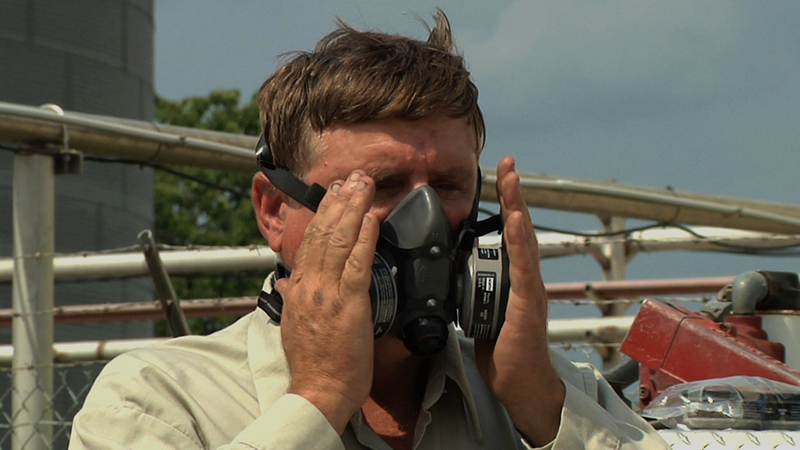
The Occupational Safety and Health Administration’s (OSHA) respirator standard requires employers to establish and maintain an effective respiratory protection program when employees must wear respirators to protect against workplace hazards. Respirators are required when engineering and workplace control measures are not adequate to prevent atmospheric contamination. Different hazards require different respirators and employees are responsible for wearing the appropriate respirator and complying with the company’s written respiratory program.
Respiratory Protection Program
Employers must develop and implement a written respiratory protection program with required worksite-specific procedures and elements for required respirator use. The program must be administered by a suitably trained program administrator. The employer must include the following provisions:
- Procedures for selecting respirators;
- Medical evaluations;
- Fit testing procedures;
- Procedures for proper use of respirators in emergency situations;
- Procedures and schedules for maintaining respirators;
- Air quality standards;
- Training; and
- Program evaluation.
Medical Evolutions
Employers must provide a medical evaluation to determine the employee’s ability to use a respirator before the employee is fit tested or required to use the respirator in the workplace. The employer may discontinue an employee’s medical evaluations when the employee is no longer required to use a respirator. The employer must provide respirators, training and medical evaluations at no cost to the employee.
Fit Testing
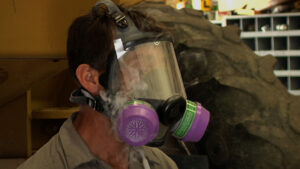
Before an employee may be required to use any respirator with a negative or positive pressure tight fitting facepiece, the employee must be fit tested with the same make, model, style and size of respirator that will be used. The standard details the kinds of fit tests allowed, the procedures for conducting them and how the results of the fit tests must be used. The employer must ensure that employees using a tight-fitting facepiece respirator pass an appropriate qualitative fit test (QLFT) or quantitative fit test (QNFT) at the following intervals:
- Prior to the first use;
- Whenever a different facepiece is used;
- At least annually;
- Whenever the employee’s physical condition changes; and
- Whenever the fit of the respirator is unacceptable.
Maintenance And Care
Employers must provide for the cleaning, disinfecting, storage, inspection and repair of respirators used by employees. They must provide each respirator user with a respirator that is clean, sanitary and in good working order. All respirators must be stored to protect them from damage, contamination, dust, sunlight, extreme temperatures, excessive moisture and damaging chemicals, and they must be packed or stored to prevent deformation of the facepiece and exhalation valve.
All respirators used in routine situations must be inspected before each use and during cleaning. All respirators maintained for use in emergency situations must be inspected at least monthly, in accordance with the manufacturer’s recommendations, and before and after each use. Emergency escape-only respirators must be inspected before being carried into the workplace for use.
Training
Employers must provide effective training to employees who are required to use respirators. Each employee must be able to demonstrate knowledge of at least the following:
- Why the respirator is necessary and how improper fit, usage or maintenance cancompromise the protective effect of the respirator;
- What the limitations and capabilities of the respirator are;
- How to use the respirator effectively in emergency situations, including situations in which the respirator malfunctions;
- How to inspect, put on and remove, use and check the seals of the respirator;
- What the procedures are for maintenance and storage of the respirator;
- How to recognize medical signs and symptoms that may limit or prevent the effective use of respirators; and
- The general requirements of the respirator standard.
Retraining must be administered annually and when the following situations occur:
- Changes in the workplace or the type of respirator render previous training obsolete;
- Inadequacies in the employee’s knowledge or use of the respirator indicate that the employee has not retained the requisite understanding or skill; or
- Any other situation arises in which retraining appears necessary to ensure safe respirator use.
Voluntary Use
Where respirator use is not required:
- An employer may provide respirators at the request of employees or permit employees to use their own respirators, if the employer determines that such respirator use will not in itself
create a hazard. If the employer determines that any voluntary respirator use is permissible, the employer must provide the respirator users with the information contained in appendix D
to this section (“Information for Employees Using Respirators When Not Required Under the Standard”); and - In addition, the employer must establish and implement those elements of a written respiratory protection program necessary to ensure that any employee using a respirator voluntarily is medically able to use that respirator, and that the respirator is cleaned, stored, and maintained so that its use does not present a health hazard to the user.
Exception: Employers are not required to include in a written respiratory protection program those employees whose only use of respirators involves the voluntary use of filtering facepieces (dust masks).
Air-purifying respirator – a respirator with an air-purifying filter, cartridge or canister that removes specific air contaminants by passing ambient air through the air-purifying element.
Atmosphere-supplying respirator – a respirator that supplies the respirator user with breathing air from a source independent of the ambient atmosphere, and includes supplied-air respirators (SARs) and self-contained breathing apparatus (SCBA) units.
Escape-only respirator – a respirator intended to be used only for emergency exit.
Qualitative fit test (QLFT) – a pass/fail fit test to assess the adequacy of respirator fit that relies on the individual’s response to the test agent.
Quantitative fit test (QNFT) – an assessment of the adequacy of respirator fit by numerically measuring the amount of leakage into the respirator.