
Written Plan
In order to eliminate or minimize the hazards of occupational exposure to bloodborne pathogens, the standard requires employers to develop and implement a written plan. Employers must identify, in writing, tasks and procedures, as well as job classifications, where occupational exposure to blood occurs, without regard to personal protective clothing and equipment. The employer must also set the schedule for implementing other provisions of the standard and specify the procedure for evaluating exposure incidents. The plan must be accessible to employees and available to OSHA. Employers must review and update it at least annually but more often if it is necessary to accommodate workplace changes.
Method of Compliance
 The standard mandates universal precautions, (treating body fluids/materials as if infectious) emphasizing engineering and work practice controls. It stresses handwashing and requires employers to provide handwashing facilities and ensure that employees use them following exposure to blood.
Employers must provide, at no cost, and require employees to use appropriate personal protective equipment (PPE) such as gloves, gowns, eye protection and face shields and must clean, repair and replace these when necessary.
The standard requires a written schedule for cleaning and method of decontamination to be used based upon the location within the facility, in addition to cleaning and decontaminating following contact with blood or other potentially infectious materials.
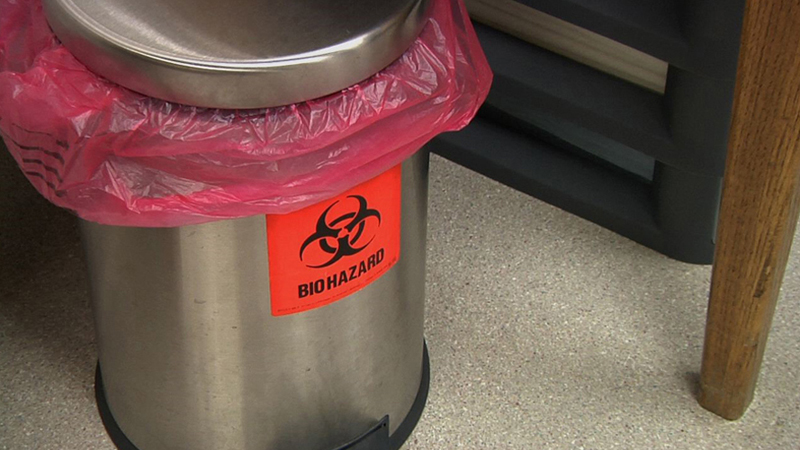
Whenever equipment, PPE, waste or other items with blood or other potentially infectious materials are present, the biohazard symbol with the legend “biohazard” must be used and bags or containers must be color-coded or have other prominent warning information or symbols.
Hepatitis B vaccinations must be offered to all workers with occupational exposure after the worker has received the required bloodborne pathogens training and within 10 days of initial assignment to a job with occupational exposure. Prescreening may not be required as a condition of receiving the vaccine. Employees must sign a declination form if they choose not to be vaccinated, but may later opt to receive the vaccine at no cost to the employee. Should booster doses later be recommended by the U.S. Public Health Service (USPHS), they must be offered to employees.
Training
Employers must ensure that their workers receive regular training that covers all elements of the standard including, but not limited to: information on bloodborne pathogens and diseases, methods used to control occupational exposure, hepatitis B vaccine and medical evaluation and post-exposure follow-up procedures. Employers must offer this training on initial assignment, at least annually thereafter and when new or modified tasks or procedures affect a worker’s occupational exposure.
Recordkeeping
Medical records must be kept for each employee with an occupational exposure incident. Training records must be maintained for three years and must include dates, contents of the training program or a summary, trainer’s name and qualifications as well as names and job titles of all persons attending the sessions.
Bloodborne pathogens – Bloodborne pathogens are infectious microorganisms in human blood that can cause disease in humans. These pathogens include, but are not limited to, Hepatitis B (HBV), Hepatitis C (HCV) and Human Immunodeficiency Virus (HIV).
Universal precautions – Treating all human blood and OPIM as if known to be infectious for bloodborne pathogens.