
Overview
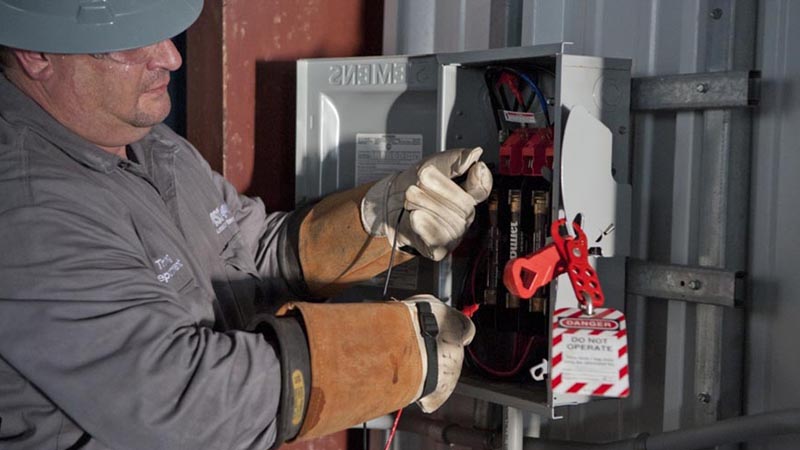
 Live parts of electric equipment operating at 50 volts or more must be guarded against accidental contact by use of approved cabinets, other forms of approved enclosures, or by any of the following means:
- By location in a room, vault or similar enclosure that is accessible only to qualified persons;
- By suitable permanent, substantial partitions or screens so arranged so that only qualified persons will have access to the space within reach of the live parts. Any openings in such partitions or screens must be so sized and located that persons are not likely to come into accidental contact with the live parts or to bring conducting objects into contact with them;
- By placement on a suitable balcony, gallery or platform so elevated and otherwise located as to prevent access by unqualified persons; or
- By elevation of 8.0 feet or more above the floor or other working surface.
In locations where electric equipment is likely to be exposed to physical damage, enclosures or guards must be so arranged and of such strength as to prevent the damage. Entrances to rooms and other guarded locations containing exposed live parts must be marked with conspicuous warning signs forbidding unqualified persons to enter.
29 CFR 1910.305(b)(1)(ii) – Unused openings in cabinets, boxes, and fittings must be effectively closed.
Covers and Canopies
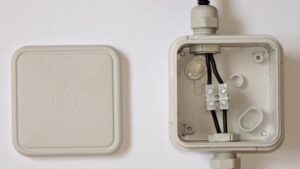
29 CFR 1910.305(b)(2)(i) – All pull boxes, junction boxes, and fittings must be provided with covers identified for the purpose. If metal covers are used, they must be grounded. In completed installations, each outlet box must have a cover, faceplate, or fixture canopy. Covers of outlet boxes having holes through which flexible cord pendants pass must be provided with bushings designed for the purpose or must have smooth, well-rounded surfaces on which the cords may bear.
Enclosures for Damp or Wet Locations
29 CFR 1910.305(e)(1) – Cabinets, cutout boxes, fittings, boxes, and panelboard enclosures in damp or wet locations must be installed so as to prevent moisture or water from entering and accumulating within the enclosures and must be mounted so there is at least 6.35-mm (0.25-in.) airspace between the enclosure and the wall or other supporting surface. However, nonmetallic enclosures may be installed without the airspace on a concrete, masonry, tile, or similar surface. The enclosures must be weatherproof in wet locations.