
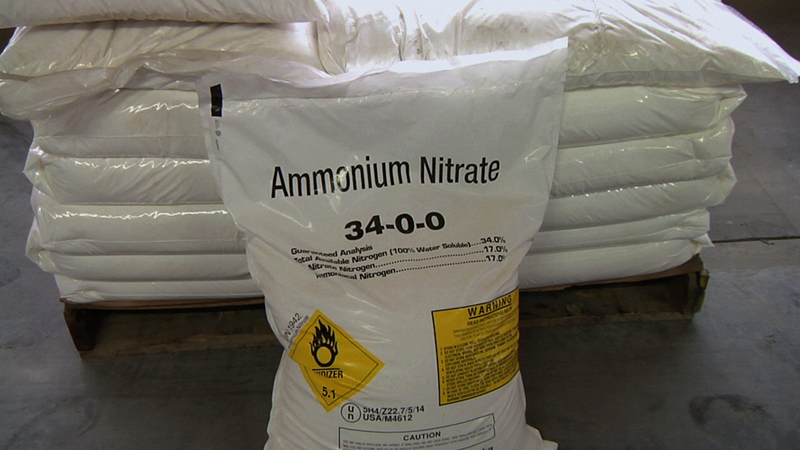
Introduction
The Occupational Safety and Health Administration (OSHA) regulates the manufacture, keeping, having, storage, sale, transportation and use of explosives and blasting agents under its Occupational Safety and Health Standards for explosives and blasting agents 29 CFR 1910.109. This regulation covers explosives and blasting agents, including ammonium nitrate and storage of all grades of ammonium nitrate.
The National Fire Protection Administration (NFPA) has developed a code for storage of ammonium nitrate, including mixtures containing 60 percent or more by weight of ammonium nitrate called NFPA 400. NFPA codes are developed through a consensus standards development process approved by the American National Standards Institute. This process brings together volunteers representing various viewpoints and interests to achieve consensus on safety issues. These codes are not binding, but may be adopted by reference into laws or regulations.
General Considerations
Storage buildings for ammonium nitrate must not have basements unless the basements are open on at least one side. Storage buildings must not be over one story in height and must have adequate ventilation or be of a construction that will be self-ventilating in the event of fire. The wall on the exposed side of a storage building, within 50 feet of a combustible building, forest, piles of combustible materials and similar exposure hazards, must be of fire-resistive construction. In lieu of the fire- resistive wall, other suitable means of exposure protection, such as a free standing wall, may be used. The roof coverings must be at least Class C.
All flooring in storage and handling areas must be of noncombustible material or protected against impregnation by ammonium nitrate, and be without open drains, traps, tunnels, pits or pockets into which any molten ammonium nitrate could flow and be confined in the event of fire. Buildings and structures must be dry and free from water seepage through the roof, walls and floors.
Bags, Drums or Other Container Storage
Bags and containers used for ammonium nitrate must comply with specifications and standards required for use in interstate commerce. Containers of ammonium nitrate must not be accepted for storage when the temperature of the ammonium nitrate exceeds 130 degrees Fahrenheit. Bags of ammonium nitrate must not be stored within 30 inches of the storage building walls and partitions.
The height of piles must not exceed 20 feet. The width of piles must not exceed 20 feet and the length 50 feet, except where the building is of noncombustible construction or is protected by automatic sprinklers, the length of piles must not be limited.
In no case can the ammonium nitrate be stacked closer than 36 inches below the roof or supporting and spreader beams overhead. Aisles must be provided to separate piles by a clear space of not less than 3 feet in width. At least one service or main aisle in the storage area must be not less than 4 feet in width.
Bulk Storage
Warehouses must have adequate ventilation or be capable of adequate ventilation in case of fire. Unless constructed of noncombustible material or adequate facilities for fighting a roof fire are available, bulk storage structures must not exceed a height of 40 feet. Bins must beclean and free of materials which may contaminate ammonium nitrate.
Due to the corrosive and reactive properties of ammonium nitrate, and to avoid contamination, galvanized iron, copper, lead and zinc must not be used in a bin construction unless suitably protected. Aluminum bins and wooden bins protected against impregnation by ammonium nitrate are permissible. The partitions dividing the ammonium nitrate storage from other products, which would contaminate the ammonium nitrate, must be of tight construction.
Piles or bins must be sized and arranged so that all material in the pile is moved out periodically in order to minimize possible caking of the stored ammonium nitrate. Height or depth of piles must be limited by the pressure-setting tendency of the product. However, in no case must the ammonium nitrate be piled higher at any point than 36 inches below the roof or supporting and spreader beams overhead.
Ammonium nitrate must not be accepted for storage when the temperature of the product exceeds 130 degrees Fahrenheit. Dynamite, other explosives and blasting agents must not be used to break up or loosen caked ammonium nitrate.
NFPA 400, 11.3.2.3.2.1 – Where bulk storage structures are constructed of noncombustible material and facilities for fighting a roof fire are provided, the height of the storage building must only be limited by the building construction type, as specified in the building code adopted by the authority having jurisdiction.
Fire Protection
 Storage buildings must have ventilation or be of a construction that will be self-ventilating in the event of fire. Suitable fire control devices, such as small hose or portable fire extinguishers, must be provided throughout the warehouse and in the loading and unloading areas. Water supplies and fire hydrants must be available in accordance with recognized good practices.
More than 2,500 tons of bagged ammonium nitrate must not be stored in a building or structure not equipped with an automatic sprinkler system. Sprinkler systems must be of the approved type and properly installed.
NFPA 400, 11.2.6.1.1 – When approved by the authority having jurisdiction, a quantity of bagged ammonium nitrate greater than 2,500 tons must be permitted to be stored in a building or structure not equipped with an automatic sprinkler system.
Segregation
Ammonium nitrate must be in a separate building or must be separated by approved type firewalls of not less than one hour fire-resistance rating from storage of any of the following: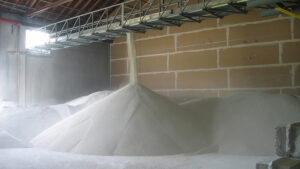
- Organic chemicals, acids or other corrosive materials;
- Compressed flammable gases;
- Flammable and combustible materials, solids or liquids; or
- Other contaminating substances.
Other contaminating substances include animal fats, baled cotton, baled rags, baled scrap paper, bleaching powder, burlap or cotton bags, caustic soda, chlorides, coal, coke, charcoal, cork, camphor, diesel fuels and oils, excelsior, fibers of any kind, finely divided metals, fish oils, fish meal, foam rubber, hay, lubricating oil, linseed oil or other oxidizable or drying oils, naphthalene, oakum, oiled clothing, oiled paper, oiled textiles, organic materials, paint, phosphorus, straw, sawdust, wood shavings or vegetable oils. In lieu of separation walls, ammonium nitrate may be separated from these materials by a space of at least 30 feet.
NFPA 400, 11.1.5.3 – Ammonium nitrate must be separated from combustible materials that could potentially cause a fire. The exterior wall on the exposed side of a storage building within 50 feet of a combustible building, forest, piles of combustible materials and exposure hazards by ordinary combustible materials must be of Type I construction in accordance with the building code. In lieu of the Type I wall, means of exposure protection such as a freestanding fire barrier wall is permitted.
Postings
The ammonium nitrate storage bins or piles must be clearly identified by signs reading “Ammonium Nitrate” with letters at least two inches high.
Other Precautions
Electrical installations must be designed to minimize damage from corrosion. In areas where lightning storms are prevalent, lightning protection must be provided.