

Introduction
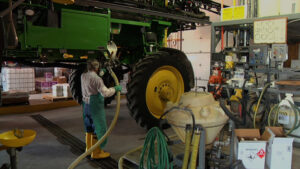 The Environmental Protection Agency (EPA) established standards for operational containment structures at certain dispensing sites. A pesticide dispensing area is subject to these containment regulations and must have a containment pad that complies with these requirements if:
- Refillable containers of agricultural pesticides are emptied, cleaned or rinsed;
- Agricultural pesticides are dispensed from a stationary pesticide container designed to hold undivided quantities of agricultural pesticides equal to or greater than 500 gallons of liquid pesticide or equal to or greater than 4,000 pounds of dry pesticide for any purpose, including refilling or emptying for cleaning. This applies when the pesticide is dispensed from the container into any other vessel such as refillable containers, service containers, transport vehicles or application equipment;
- Agricultural pesticides are dispensed from a transport vehicle for purposes of filling a refillable container; or
- Agricultural pesticides are dispensed from any other container for the purpose of refilling a refillable container for sale or distribution.
Existing Containment Structures
All existing containment structures must be made of steel, reinforced concrete or other rigid material capable of withstanding the full hydrostatic head, load and impact of any pesticides, precipitation, other substances, equipment and appurtenances placed in the structure. The structure must be liquid- tight with cracks, seams and joints appropriately sealed. It must not be constructed of natural earthen material, unfired clay or asphalt. The containment structure must be made of materials compatible with the pesticides stored. The general design requirements must protect appurtenances and pesticide containers against damage from operating personnel and moving equipment. This can be done by using supports to prevent sagging, flexible connections, the use of guard rails, barriers and protective cages, or similar means.
All appurtenances, discharge outlets and gravity drains through the base or wall of the containment structure, except for direct interconnections between adjacent containment structures, must be sealed. The containment structure must be constructed with sufficient freeboard to contain precipitation and prevent water and other liquids from seeping into or flowing onto it from adjacent land or structures. Multiple stationary pesticide containers may be protected within a single secondary containment unit.
Existing containment pads in pesticide dispensing areas, which have a pesticide container or pesticide- holding equipment with a volume of 750 gallons or greater, must have a holding capacity of at least 750 gallons. Existing containment pads in pesticide dispensing areas, which do not have a pesticide container or pesticide-holding equipment with a volume of at least 750 gallons, must have a holding capacity of at least 100 percent of the volume of the largest pesticide container or pesticide-holding equipment used on the pad.
Each existing containment pad in a pesticide dispensing area must be designed and constructed to intercept leaks and spills of pesticides, which may occur in the pesticide dispensing area. The containment must have enough surface area to extend completely beneath any container on it, with the exception of transport vehicles dispensing pesticide for sale or distribution to a stationary pesticide container. For these, the surface area of the containment pad must accommodate at least the portion of the vehicle where the delivery hose or device couples to the vehicle. This exception does not apply to transport vehicles that are used for prolonged storage or repeated on-site dispensing of pesticides. The containment pad must allow, in conjunction with its sump, for removal and recovery of spilled, leaked or discharged material and rainfall, such as by a manually activated pump. Automatically activated pumps which lack automatic overflow cutoff switches for the receiving container are prohibited.
State Requirements
 Employers should check with appropriate regulatory groups, such as the state Environmental Protection Agency (EPA), Department of Environmental Quality, Department of Agriculture or State Chemist Office for more information. Many states have requirements for containment pads that exceed federal rules. For instance, some states require 1000 gallon capacity; others require capacity exceeding the largest container – even if the container is a truck. Comply with whichever requirements are most strict.
States with existing containment programs must submit a letter and any supporting documentation to EPA to have the option of continuing to implement their own programs in lieu of the Federal regulations. Supporting documentation must demonstrate that the State’s program is providing environmental protection equivalent to, or more protective, than that expected to be provided by the Federal regulations in this subpart.