
Overview
 The Occupational Health and Safety Administration (OSHA) provides requirements for the drainage, dikes and walls of aboveground tanks of flammable liquids. The area surrounding a tank or a group of tanks must be provided with drainage, or must be diked, to prevent accidental discharge of liquid from endangering adjoining property or reaching waterways. Where protection of adjoining property or waterways is by means of a natural or manmade drainage system, the drainage system must terminate in vacant land or other area or in an impounding basin having a capacity not smaller than that of the largest tank served. This termination area and the route of the drainage system must be so located that, if the flammable liquids in the drainage system are ignited, the fire will not seriously expose tanks or adjoining property.
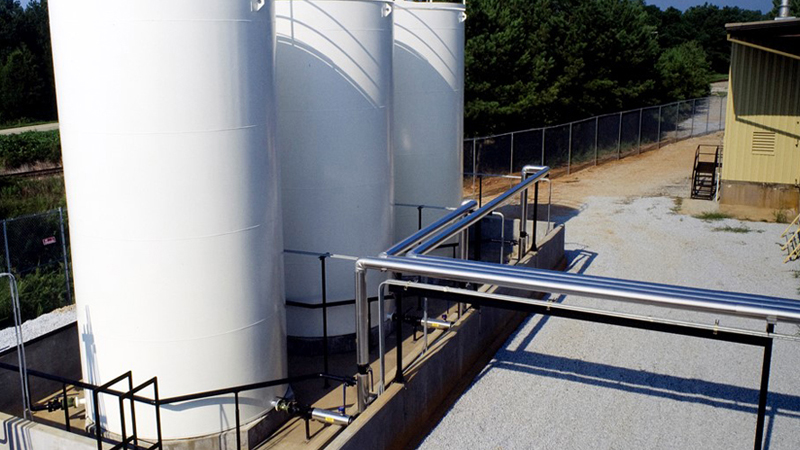
Where protection of adjoining property or waterways is accomplished by retaining the liquid around the tank by means of a dike, the volume capacity of the diked area must not be less than the greatest amount of liquid that can be released from the largest tank within the diked area, assuming a full tank. The capacity of the diked area enclosing more than one tank, must be calculated by deducting the volume of the tanks, other than the largest tank, below the height of the dike.
Walls of the diked area must be of earth, steel, concrete or solid masonry, designed to be liquidtight and to withstand a full hydrostatic head. Earthen walls three feet or more in height must have a flat section at the top not less than two feet wide. The slope of an earthen wall must be consistent with the angle of repose of the material of which the wall is constructed. The walls of the diked area shall be restricted to an average height of six feet above interior grade. Loose combustible materials, drums or barrels are not permitted within the diked area.