
Introduction
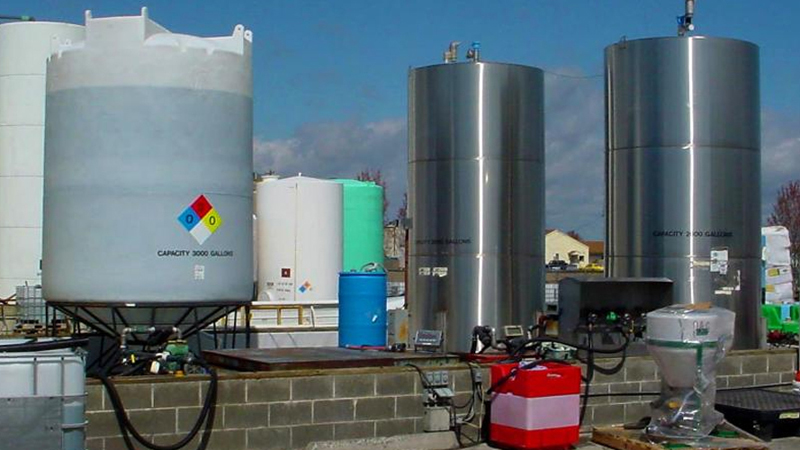
 The Environmental Protection Agency (EPA) established standards for secondary containment structures for stationary pesticide containers. Stationary pesticide containers designed to hold undivided quantities of agricultural pesticides equal to or greater than 500 gallons of liquid pesticide or equal to or greater than 4,000 pounds of dry pesticide must have a secondary containment unit, unless any of the following conditions exists:
- The container is empty, that is, all pesticide that can be removed by methods such as draining, pumping or aspirating has been removed (whether or not the container has been rinsed or washed);
- The container holds only pesticide rinsates or wash waters and is labeled accordingly;
- The container holds only pesticides which would be gaseous when released at atmospheric temperature and pressure; or
- The container is dedicated to non-pesticide use and is labeled accordingly.
Existing Secondary Containment Structures
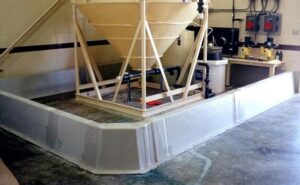
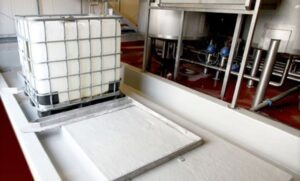 All existing containment structures must be made of steel, reinforced concrete or other rigid material capable of withstanding the full hydrostatic head, load and impact of any pesticides, precipitation, other substances, equipment and appurtenances placed in the structure. The structure must be liquid- tight with cracks, seams and joints appropriately sealed. It must not be constructed of natural earthen material, unfired clay or asphalt. The containment structure must be made of materials compatible with the pesticides stored. The general design requirements must protect appurtenances and pesticide containers against damage from operating personnel and moving equipment. This can be done by using supports to prevent sagging, flexible connections, the use of guard rails, barriers and protective cages, or similar means.
All appurtenances, discharge outlets and gravity drains through the base or wall of the containment structure, except for direct interconnections between adjacent containment structures, must be sealed. The containment structure must be constructed with sufficient freeboard to contain precipitation and prevent water and other liquids from seeping into or flowing onto it from adjacent land or structures. Multiple stationary pesticide containers may be protected within a single secondary containment unit.
Existing secondary containment units for stationary containers of liquid pesticides must have a capacity of at least 100 percent of the volume of the largest stationary pesticide container, plus the volume displaced by other containers and appurtenances within the unit. You must either anchor or elevate each stationary container of liquid pesticides protected by an existing secondary containment unit to prevent flotation in the event that the secondary containment unit fills with liquid.
Stationary containers of dry pesticides within the containment unit must be protected from wind and precipitation. They must be placed on pallets or a raised concrete platform to prevent the accumulation of water in or under the pesticide. The storage area for stationary containers of dry pesticides must include a floor that extends completely beneath the pallets or raised concrete platforms on which the stationary containers of dry pesticides must be stored. The storage area for stationary containers of dry pesticides must be enclosed by a curb a minimum of 6 inches high that extends at least 2 feet beyond the perimeter of the container.
State Requirements
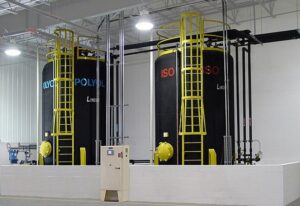 Employers should check with appropriate regulatory groups, such as the state Environmental Protection Agency (EPA), Department of Environmental Quality, Department of Agriculture or State Chemist Office for more information. Comply with whichever requirements are most strict.
States with existing containment programs must submit a letter and any supporting documentation to EPA to have the option of continuing to implement their own programs in lieu of the Federal regulations. Supporting documentation must demonstrate that the State’s program is providing environmental protection equivalent to, or more protective than, that expected to be provided by the Federal regulations in this subpart.
Stationary pesticide container – a refillable container that is fixed at a single facility or establishment, or, if not fixed, remains at the facility or establishment for at least 30 consecutive days and holds pesticide the entire time.