
General Requirements
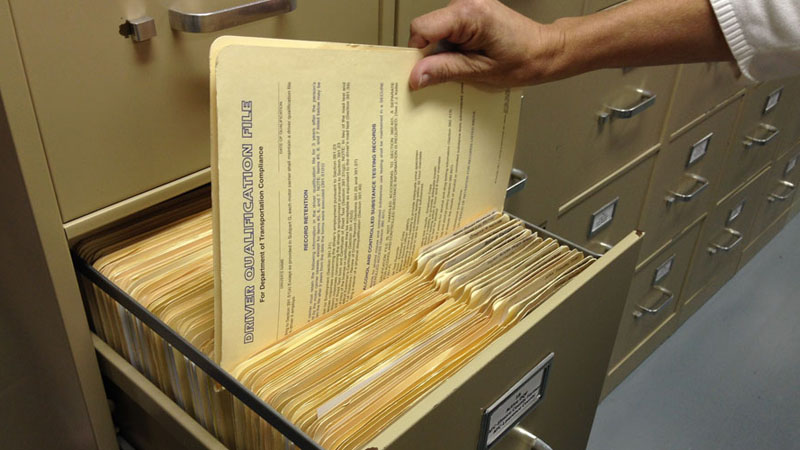
Driver qualification files are required for any person who: operates a commercial motor vehicle with a Gross Vehicle Weight Rating (GVWR) of 10,001 pounds or more, operates a commercial motor vehicle to transport a placarded quantity of a hazardous material, or operates a commercial motor vehicle used to transport more than 15 passengers, including the driver. Each motor carrier must maintain a driver qualification file for each driver it employs. Qualification files for drivers must include:

- Medical examiner’s certificate*
- Note verifying medical examiner is listed National Registry of Certified Medical Examiners**
- Documentation of an annual review
- Application for employment
- Documentation of request for check of driving record
- Record and certificate of road test
- Request for information from previous employer
- Any applicable notice of disqualification or medical waivers
* Beginning June 23, 2025, for a driver required to have a commercial driver’s license or a commercial learner’s permit, the motor carrier must obtain the CDLIS motor vehicle record to verify the medical certification status information.
** Beginning June 23, 2025, for a driver required to have a commercial driver’s license or a commercial learner’s permit, this is no longer required.
The following items may be required but are not necessarily required to be placed in the driver qualification file:
- Certificate of non-motor carrier compensated work
- Pre-employment urinalysis notification
- Certification of compliance with driver’s license
- Controlled substance test results
- Documentation of hazardous material, substance abuse or other pertinent training
- Any applicable substance abuse results or information from previous employers
Driver qualification files must be maintained at the motor carrier’s principle place of business for as long as a driver is employed, and for 3 years thereafter.
Annual Review
Each motor carrier must, at least once every 12 months, make an inquiry to obtain the motor vehicle record of each driver it employs, review the motor vehicle record and maintain a copy of the driver’s record and a record including the name of the person who performed the review of the driving record in the driver’s qualification file.
Pre-Employment Drug Testing
Prior to the first time a Commercial Driver’s License (CDL) driver performs safety-sensitive functions for an employer, the driver must have testing for controlled substances as a condition prior to being used. No employer can allow a CDL driver, who the employer intends to hire or use, to perform safety-sensitive functions unless the employer has received a controlled substances test result from the Medical Review Officer (MRO) or consortium administrator indicating a verified negative test result for that driver.
Random Drug Testing
Motor carriers must ensure all CDL drivers are subject to a random drug-testing program designed to be unannounced on an ongoing basis, spread reasonably throughout the calendar year, using a scientifically valid method in which each covered employee has an equal chance of being selected for testing. Owner-operators, operating under their own US DOT numbers, are required to belong to a consortium to be in compliance with the random testing requirement.
Commercial motor vehicle – any self-propelled or towed motor vehicle used on a highway in interstate commerce to transport passengers or property when the vehicle:
- Has a gross vehicle weight rating or gross combination weight rating, or gross vehicle weight or gross combination weight, of 4,536 kilograms (10,001 pounds) or more, whichever is greater; or
- Is designed or used to transport more than 8 passengers (including the driver) for compensation; or
- Is designed or used to transport more than 15 passengers, including the driver, and is not used to transport passengers for compensation; or
- Is used in transporting hazardous material and transported in a quantity requiring placarding.
Interstate commerce – means trade, traffic or transportation in the United States:
- Between a place in a State and a place outside of such State;
- Between two places in a State through another State or a place outside of the United States; or
- Between two places in a State as part of trade, traffic or transportation originating or terminating outside the State or the United States