
Overview
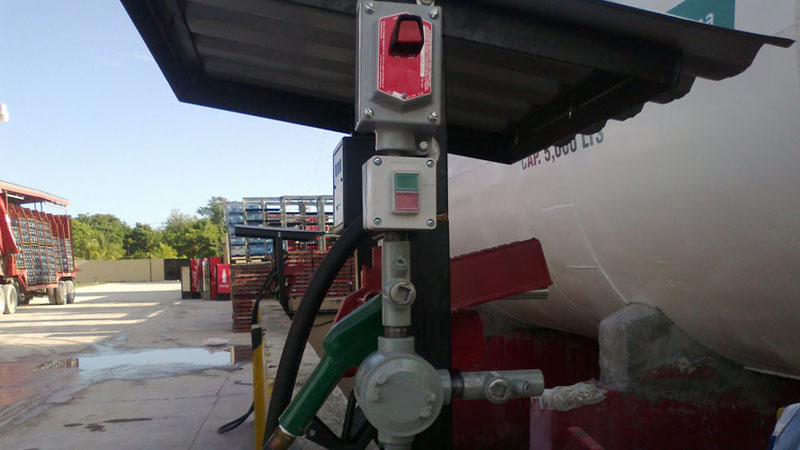
 Within 25 feet of hazardous locations, electrical equipment, wiring methods and installation of equipment must be intrinsically safe or approved for the hazardous location. This includes bulk storage tanks used for gasoline. Equipment must be approved not only for the class of location, but also for the ignitable or combustible properties of the specific gas, vapor, dust or fiber that will be present.
The National Electrical Code, NFPA 70, lists or defines hazardous gases, vapors and dusts by “Groups” characterized by their ignitable or combustible properties. Equipment must be marked to show the class, group and operating temperature or temperature range, based on operation in a 40-degree Celsius ambient, for which it is approved. The temperature marking may not exceed the ignition temperature of the specific gas or vapor to be encountered.
NFPA 70 also addresses guidelines for electric wiring, equipment, and systems installed in hazardous (classified) locations and contains specific provisions for the following: wiring methods, wiring connections, conductor insulation, flexible cords, sealing and drainage, transformers, capacitors, switches, circuit breakers, fuses, motor controllers, receptacles, attachment plugs, meters, relays, instruments, resistors, generators, motors, lighting fixtures, storage battery charging equipment, electric cranes, electric hoists and similar equipment, utilization equipment, signaling systems, alarm systems, remote control systems, local loud speaker and communication systems, ventilation piping, live parts, lightning surge protection and grounding.
NFPA 70E Section 5-2.3 – All conduits must be threaded and must be made wrench tight. Where it is impossible to make a threaded joint tight, a bonding jumper must be utilized. If gasoline storage tanks are greater than 1,100 gallon capacity and/or if local codes require, explosion proof wiring must be used.