
Overview
The Entry-Level Driver Training (ELDT) regulation sets the minimum Federal requirements for training that entry-level drivers must complete before being permitted to take certain commercial driver’s license (CDL) skills or knowledge tests beginning February 7, 2022. Training providers must register with FMCSA via the Training Provider Registry and electronically submit a driver’s certification of successful completion of training. Training providers must comply with applicable laws and regulations of any State where in-person training is conducted.
Training Curriculum
 Theory Instruction
- Basic Operation (7 topics)
- Safe Operating Procedures (7 topics)
- Advanced Operating Practices (3 topics)
- Vehicle Systems and Reporting Malfunctions (3 topics)
- Non-Driving Activities (10 topics)
Note: There is no required minimum number of instruction hours for theory training, but the training instructor must cover all topics set forth in the curriculum. See Appendix A through E to Part 380 for details.
Behind-The-Wheel (BTW) – (Range)
- Vehicle Inspection
- Straight Line Backing
- Alley Dock Backing
- Off-Set Backing
- Parallel Parking Blind Side
- Parallel Parking Sight Side
- Coupling and Uncoupling
Behind-The-Wheel (BTW) – (Public Road)
- Vehicle Controls
- Shifting/Transmission
- Communications/Signaling
- Visual Search
- Speed and Space Management
- Safe Driver Behavior
- Hours of Service (HOS) Requirements
- Hazard Perception
- Railroad (RR)-Highway Grade Crossing
- Night Operation
- Extreme Driving Conditions
- Skid Control/Recovery, Jackknifing, and Other Emergencies
Note: There is no required minimum number of instruction hours for BTW (range and public road) training, but the training instructor must cover all topics set forth in the BTW curriculum.
Facilities
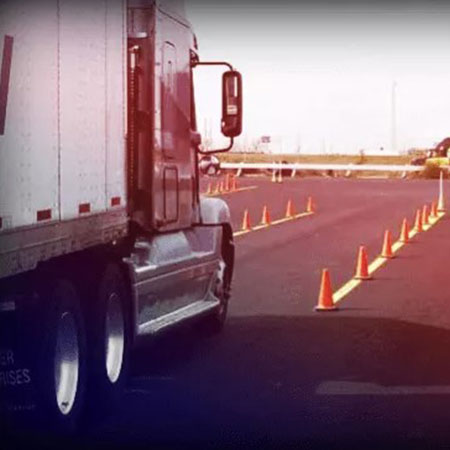
The training provider’s classroom and range facilities must comply with all applicable Federal, State, and/or local statutes and regulations. The range must be free of obstructions and allows the driver to maneuver safely without interference from other vehicles or hazards.
Vehicles
All vehicles used in the Behind-The-Wheel training must comply with applicable Federal and State safety requirements. Training vehicles must be in the same group and type that driver-trainees intend to operate for their CDL skills test.
Instructors
Theory and Behind-The-Wheel instructors must hold an appropriate class CDL with appropriate endorsements and have at least 2 years of required experience. They must also meet all applicable State qualification requirements for CMV instructors.
Assessments
Training providers must use written assessments to determine driver-trainee’s proficiency in the knowledge objectives in the theory portion of each unit of instruction. The driver-trainee must receive an overall minimum score of 80 percent on the theory assessment. Training instructors must evaluate and document a driver-trainee’s proficiency in BTW skills. While there is no minimum number of clock hours required by Federal regulation, instructors must document the total number of clock hours each driver-trainee spends to complete the Behind-The-Wheel curriculum.
Recordkeeping
 Training providers must keep the following for a minimum of 3 years:
- Self-certifications by all applicants for BTW training
- Copy of the driver-trainee’s commercial learner’s permit(s) or commercial driver’s license
- Instructor qualification documentation indicating driving and/or training experience for each instructor and copies of commercial driver’s licenses and applicable endorsements
- The lesson plans for theory and BTW (range and public road) training curricula
- Records of individual entry-level driver training assessments