
Overview
 The Occupational Safety and Health Administration (OSHA) requires employers to provide protection for each employee exposed to fall hazards and establishes performance, care and use criteria for all personal fall protection systems. The rule requires employers to protect workers from fall hazards along unprotected sides or edges that are at least 4 feet above a lower level.
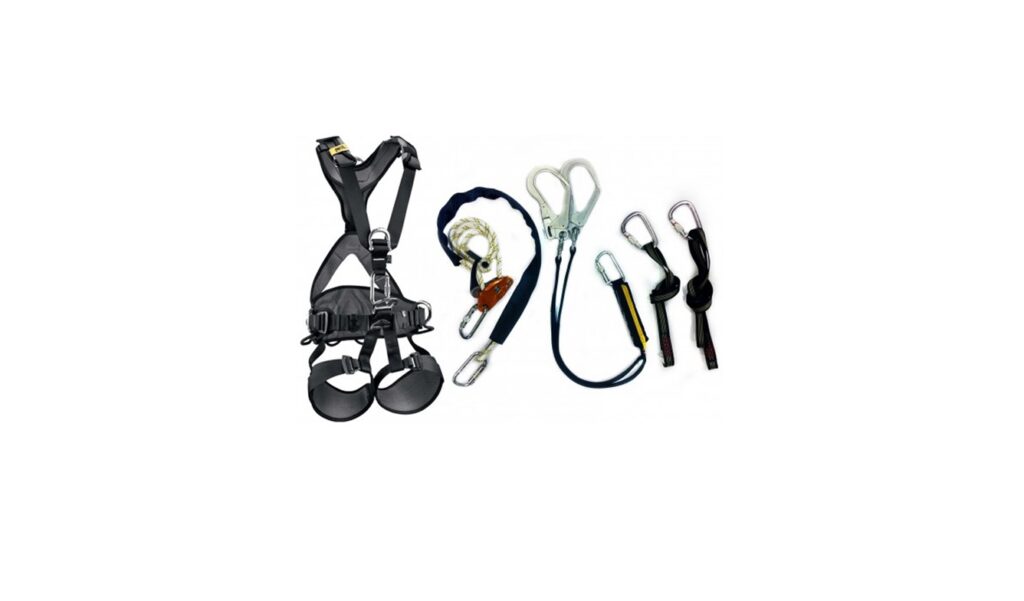
Personal fall arrest systems stop a worker’s fall from a height and can include the following:
- Anchorage;
- Connectors;
- Body harness;
- Lanyard;
- Deceleration device; and
- Lifelines.
Body belts are prohibited as part of a personal fall arrest system.
Care and Use
Personal fall arrest systems must be rigged such that an employee can neither free fall more than six feet, nor contact any lower level. The attachment point of the body harness must be located in the center of the wearer’s back near shoulder level or in the pre-sternal position if the free fall distance is limited to 2 feet. When vertical lifelines are used, each employee must be provided with a separate lifeline. Personal fall arrest systems or components must be used only for employee fall protection.
When stopping a fall, personal fall arrest systems must:
- Limit maximum arresting force on an employee to 1,800 pounds;
- Bring an employee to a complete stop and limit maximum deceleration distance an employee travels to 3.5 feet;
- Have sufficient strength to withstand twice the potential impact energy of an employee free falling a distance of 6 feet or the free fall distance permitted by the system; and
- Sustain the employee within the system or strap configuration without making contact with the employee’s neck and chin area.
Devices used to connect to a horizontal lifeline, which may become a vertical lifeline, must be capable of locking in either direction on the lifeline. Snaphooks and carabiners must not be connected to any of the following:
- Directly to webbing, rope or wire rope;
- To each other;
- To a D-ring to which another snaphook, carabiner or connector is attached;
- To a horizontal lifeline; or
- To any object which is incompatibly shaped or dimensioned in relation to the snaphook or carabiner such that unintentional disengagement could occur.
Anchorages used to attach to personal fall protection equipment must be independent of any anchorage used to suspend employees or platforms on which employees work. Anchorages used to attach to personal fall protection equipment on mobile work platforms on powered industrial trucks must be attached to an overhead member of the platform, at a point located above and near the center of the platform. The employer must provide for prompt rescue of each employee in the event of a fall.
Training
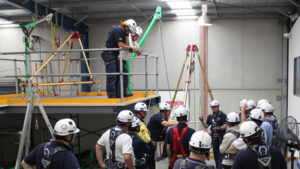
Before using a personal fall arrest system, and after any component or system is changed, employees must be trained in the proper use of the system. Training should stress the importance of inspections prior to use, the limitations of the equipment to be used and unique conditions at the worksite that may be important.
Inspections
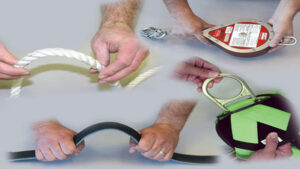
Personal fall arrest systems must be inspected prior to each use for mildew, wear, damage and other deterioration, and defective components must be removed from service if their strength or function may be adversely affected. Personal fall arrest systems or components subjected to impact loading must be immediately removed from service and must not be used again for employee protection unless inspected and determined by a competent person to be undamaged and suitable for reuse. A qualified person must inspect each knot in a lanyard or vertical lifeline before employee use.
Design for System Components
 Connectors must be drop forged, pressed or formed steel or made of equivalent materials. Connectors must have a corrosion-resistant finish, and all surfaces and edges must be smooth to prevent damage to interfacing parts of the system. Lanyards and vertical lifelines which tie-off one employee must have a minimum breaking strength of 5,000 pounds.
Self-retracting lifelines and lanyards which automatically limit free fall distance to two feet or less, must have components capable of sustaining a minimum static tensile load of 3,000 pounds applied to the device with the lifeline or lanyard in the fully extended position.
D-rings and snaphooks must be capable of sustaining a minimum tensile load of 5,000 pounds. D-rings, snaphooks and carabiners must be proof-tested to a minimum tensile load of 3,600 pounds without cracking, breaking or taking permanent deformation. The gate strength of snaphooks and carabiners must be capable of withstanding a minimum load of 3,600 pounds without the gate separating from the nose of the snaphook or carabiner body by more than 0.125 inches. Snaphooks and carabiners must be the automatic locking type that require at least two separate, consecutive movements to open.
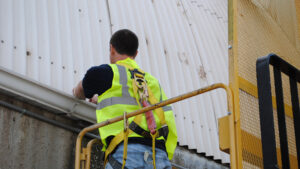 Horizontal lifelines, where used, must be designed and installed as part of a complete personal fall arrest system, which maintains a safety factor of at least two, under the supervision of a qualified person. Anchorages to which personal fall arrest equipment is attached, must be capable of supporting at least 5,000 pounds per employee attached, or must be designed, installed and used as part of a complete personal fall arrest system, which maintains a safety factor of at least two, under the supervision of a qualified person.
Travel restraint lines must be capable of sustaining a tensile load of at least 5,000 pounds. Lifelines must not be made of natural fiber rope. Polypropylene rope must contain an ultraviolet (UV) light inhibitor. Ropes, belts, lanyards and harnesses used for personal fall protection must be compatible with all connectors used, and must be protected from being cut, abraded, melted or otherwise damaged.
Personal fall arrest system – system (including all components) an employer uses to provide protection from falling or to safely arrest an employee’s fall if one occurs. Examples of personal fall protection systems include personal fall arrest systems, positioning systems and travel restraint systems.