
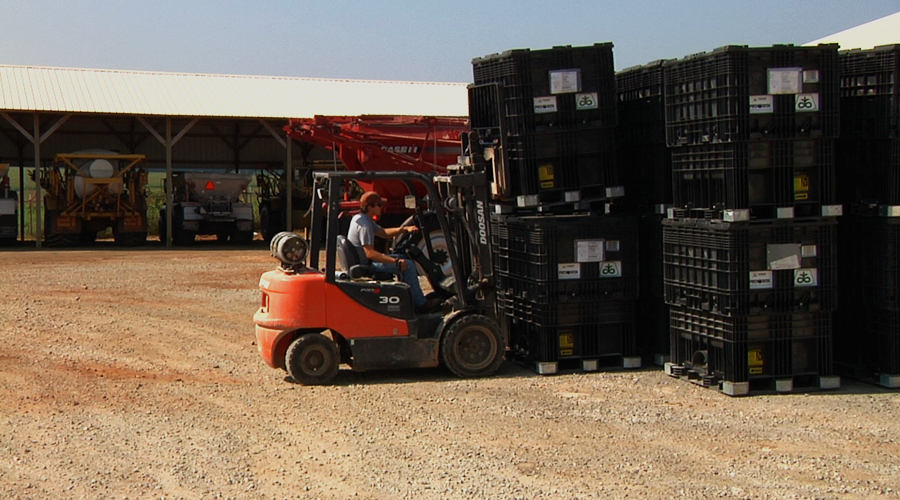
Introduction
Powered industrial trucks include:
- Fork trucks;
- Tractors;
- Platform lift trucks;
- Motorized hand trucks; and
- Other industrial trucks powered by electric motors or internal combustion engines.
Training
 The employer must ensure that each powered industrial operator is competent to operate a powered industrial truck safely prior to permitting an employee to operate the equipment. Training must consist of a combination of formal instruction (i.e., lecture, discussion, interactive computer learning, video tape and written material), practical training demonstrations performed by the trainer, practical exercises performed by the trainee and evaluation of the operator’s performance in the workplace. All operator training and evaluation must be conducted by those who have the knowledge, training and experience to train powered industrial truck operators and evaluate their competence.
Powered industrial truck operators must receive initial training in the following applicable truck-related topics:
- Operating instructions, warnings and precautions for the types of truck the operator will be authorized to operate;
- Differences between the truck and the automobile;
- Truck controls and instrumentation: where they are located, what they do and how they work;
- Engine or motor operation;
- Steering and maneuvering;
- Visibility (including restrictions due to loading);
- Fork and attachment adaptation, operation and use limitations;
- Vehicle capacity;
- Vehicle stability;
- Any vehicle inspection and maintenance that the operator will be required to perform;
- Refueling and/or charging and recharging of batteries;
- Operating limitations;
- Any other operating instructions, warnings or precautions listed in the operator’s manual for the types of vehicle that the employee is being trained to operate.
Powered industrial truck operators must receive initial training in the following applicable workplace related topics:
- Surface conditions where the vehicle will be operated;
- Composition of loads to be carried and load stability;
- Load manipulation, stacking and unstacking;
- Pedestrian traffic in areas where the vehicle will be operated;
- Narrow aisles and other restricted places where the vehicle will be operated;
- Hazardous (classified) locations where the vehicle will be operated;
- Ramps and other sloped surfaces that could affect the vehicle’s stability;
- Closed environments and other areas where insufficient ventilation or poor vehicle maintenance could cause a buildup of carbon monoxide or diesel exhaust;
- Other unique or potentially hazardous environmental conditions in the workplace that could affect safe operation; and
- The requirements of 29 CFR 1910.178.
Refresher training, including an evaluation of the effectiveness of that training, must be conducted to ensure that the operator has the knowledge and skills needed to operate the powered industrial truck safely. Refresher training must be provided when:
- The operator has been observed to operate the vehicle in an unsafe manner;
- The operator has been involved in an accident or near-miss incident;
- The operator has received an evaluation that reveals that the operator is not operating the truck safely;
- The operator is assigned to drive a different type of truck; or
- A condition in the workplace changes in a manner that could affect safe operation of the truck.
Each operator must be evaluated at least every three years. The certification must include the name of the operator, the date of the training, the date of the evaluation and the names of those performing the training or evaluation.
Maintenance
 Any power-operated industrial truck that is not in safe operating condition must be removed from service. All repairs must be made by authorized personnel. Those repairs to the fuel and ignition systems of industrial trucks which involve fire hazards must be conducted only in locations designated for such repairs. Trucks in need of repairs to the electrical system must have the battery disconnected prior to such repairs. All parts requiring replacement must be replaced only by parts equivalent to those used in the original design.
Equipment must be maintained in good condition with records documenting maintenance and repairs. Powered industrial trucks must be examined before being placed in service, and must not be placed in service if the examination shows any condition adversely affecting the safety of the vehicle. Such examination must be made at least daily. Industrial trucks must be examined after each shift when used on a round-the-clock basis. Defects must be immediately reported and corrected.
Additional Considerations
OSHA’s current enforcement policy on the use of seat belts on powered industrial trucks is that employers must require operators of powered industrial trucks equipped with operator restraint devices, including seat belts, to use the devices. Note that 29 CFR 1910.178(q)(6) prohibits employers from removing seat belts from powered industrial trucks. Additional counterweighing of fork trucks must not be done unless approved by the truck manufacturer.
A horn must be present and operable and the driver must be required to slow down and sound the horn at cross aisles and other locations where vision is obstructed