
Overview
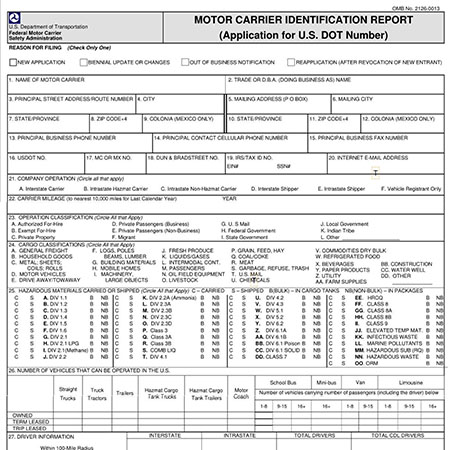
 Beginning January 1, 2005, motor carriers were required to have a Hazardous Materials Safety Permit. A carrier filing the MCS-150B form starts the application process. A carrier that does not have a USDOT Number will receive one by filing the MCS-150B. The following hazardous materials carried in these quantity amounts require an HM Safety Permit:
- Radioactive Materials: A highway route-controlled quantity of Class 7 material;
- Explosives: More than 55 pounds net weight of a Division 1.1, 1.2 or 1.3 material, or an amount of a Division 1.5 material requiring a placard;
- Toxic by Inhalation Materials: Hazard Zone A: More than 1.08 quarts per package of a “material poisonous by inhalation,” that meets the criteria for “hazard zone A”;
- Hazard Zone B: A “material poisonous by inhalation,” that meets the criteria for “hazard zone B,” in a bulk packaging;
- Hazard Zone C & D: A “material poisonous by inhalation,” that meets the criteria for “hazard zone C,” or “hazard zone D,” in a packaging having a capacity equal to or greater than 3,500 gallons; or
- Methane: A shipment of compressed or refrigerated liquefied methane or liquefied natural gas or other liquefied gas with a methane content of at least 85% in a bulk packaging having a capacity equal to or greater than 3,500 gallons for liquids or gases.
Even though anhydrous ammonia is regulated domestically as a non-flammable gas, ammonia still meets the definition of a toxic by inhalation material Hazard Zone D and is covered when transported in a packaging having a capacity greater than 3,500 gallons. Regarding LP-Gas, only shipments of flammable gas containing at least 85% methane content are covered by the HM Safety Permit program.