
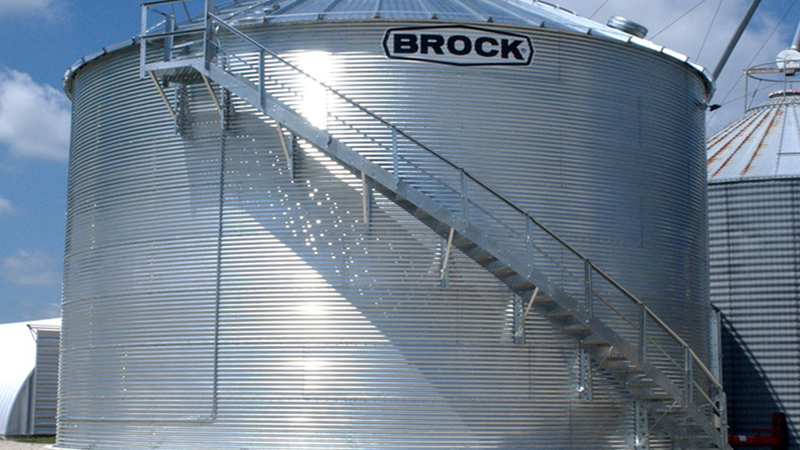
Fixed Stairs
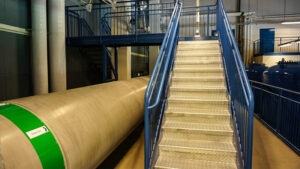 Fixed stairs must be provided for access from one walking-working surface to another where operations necessitate regular and routine travel between levels. Fixed stairways must:
- Have a minimum width of 22 inches;
- Have a minimum tread depth of 9.5 inches;
- Have a maximum riser height of 9.5 inches; and
- Be installed at horizontal angles between 30 and 50 degrees.
Rise height and tread width must be uniform throughout any flight of stairs. Stairway landings and platforms must be no less than the width of a stairway and a minimum of 30 inches in length measured in the direction of travel. Vertical clearance above any stair tread to an overhead obstruction must be at least 6 feet, 8 inches measured from the leading edge of the tread. Each stair must be able to support at least 5 times the normal anticipated load, but never less than a concentrated load of 1,000 pounds applied at any point.
Employees exposed to an unprotected side or edge of a stairway landing that is 4 feet or more above a lower level must be protected by a guardrail or stair rail system. Each flight of stairs having at least 3 treads and at least 4 risers must be equipped with stair rail systems and handrails as follows:

The height of stair rail systems installed before January 17, 2017 is not less than 30 inches from the leading edge of the stair tread to the top surface of the top rail. The height of stair rail systems installed on or after January 17, 2017 is not less than 42 inches from the leading edge of the stair tread to the top surface of the top rail.
Fixed Ladders
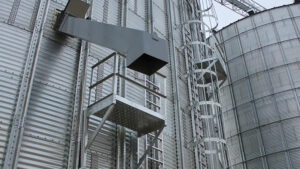 Fixed ladders may be used for access to elevated tanks, tanks and similar structures. Fixed ladders must be a minimum of 16 inches in width. Ladder rungs, steps and cleats must be spaced not less than 10 inches and not more than 14 inches apart, as measured between the centerlines of the rungs, cleats and steps unless used in an elevator shaft or communications tower. The minimum perpendicular distance from the centerline of the steps or rungs, to the nearest permanent object in back of the ladder is 7 inches. There is an exception for elevator pit ladders, which have a minimum perpendicular distance of 4.5 inches.
Fixed ladders having a pitch greater than 90 degrees from the horizontal are not to be used. The step-across distance from the centerline of the rungs or steps is not less than 7 inches and not more than 12 inches to the nearest edge of the structure, building or equipment accessed from the ladders for through ladders. The step-across distance from the centerline of the rungs or steps is not less than 15 inches and not more than 20 inches to the access points of the platform edge for side-step ladders.
Each fixed ladder installed before November 19, 2018 must be equipped with a personal fall arrest system, ladder safety system, cage or well. After November 19, 2018, new fixed ladders must be equipped with a personal fall arrest system or a ladder safety system. By November 18, 2036, all fixed ladders will need to be equipped with a personal fall arrest system or a ladder safety system.
All ladders are to be inspected before initial use in each work shift, and more frequently as necessary, to identify any visible defects that could cause employee injury.