
Overview
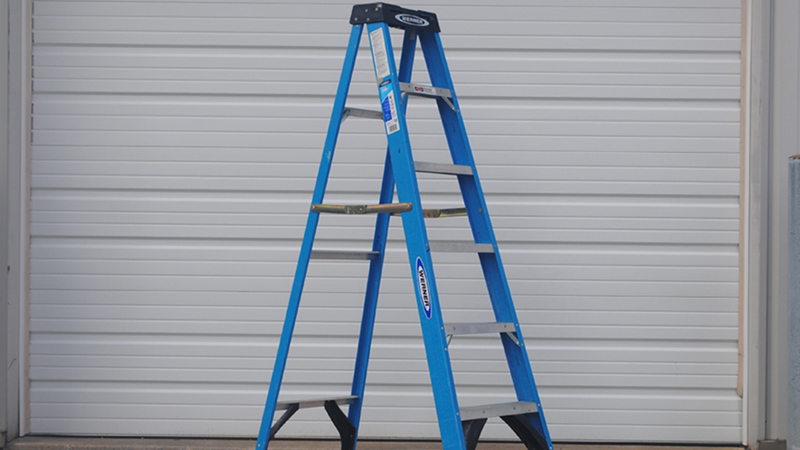
Ladders must be maintained in good usable condition at all times. 29 CFR 1910.23 prescribes rules and establishes minimum requirements for the construction, care and use of portable ladders, in order to ensure safety under normal conditions of usage. Ladders used in emergency operations and ladders designed into machines or equipment are not specifically covered by this section.
Construction Requirements
 Ladder rungs, steps and cleats must be spaced not less than 10 inches and not more than 14 inches apart, as measured between the centerlines of the rungs, steps and cleats. They must also have a minimum clear width of 11.5 inches on portable ladders. Wooden ladders must not be coated with any material that may obscure structural defects. Metal ladders are made with corrosion-resistant material or protected against corrosion.
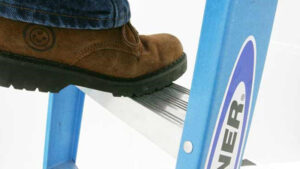
Rungs and steps of portable metal ladders must be corrugated, knurled, dimpled, coated with skid- resistant material or treated to minimize slipping. Each stepladder or combination ladder used in a stepladder mode must be equipped with a metal spreader or locking device that securely holds the front and back sections in an open position while the ladder is in use.
Inspection
Ladders must be inspected before initial use in each work shift, and more frequently as necessary, to identify any visible defects that could cause employee injury. Ladder surfaces must be free of puncture and laceration hazards. Any ladder with structural or other defects must be immediately tagged “Dangerous: Do Not Use” and be removed from service until repaired or replaced.
Ladder Use
 Ladders are to be used only for the purposes for which they were designed. Employee must face the ladder when climbing up or down it, using at least one hand to grasp the ladder. No employee should carry any object or load that could cause the employee to lose balance and fall while climbing up or down the ladder. Ladder rungs, steps and cleats must be parallel, level and uniformly spaced when the ladder is in position for use. Portable ladders used on slippery surfaces must be secured and stabilized.
Ladders are not to be loaded beyond the maximum intended load. The maximum intended load includes the total load (weight and force) of the employee and all tools, equipment and materials being carried. Ladders are to be used only on stable and level surfaces unless they are secured or stabilized to prevent accidental displacement.
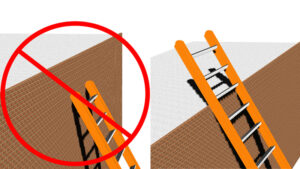
No portable single rail ladders are to be used. Ladders must not be moved, shifted or extended while an employee is on it. The cap and top step of a stepladder are not to be used as steps. The top of a non-self-supporting ladder must be placed so that both side rails are supported, unless the ladder is equipped with a single support attachment. Ladders must not be placed on boxes, barrels or other unstable bases to obtain additional height.
Ladders placed in locations such as passageways, doorways or driveways where they can be displaced must be secured to prevent accidental displacement or guarded by a temporary barricade, such as a row of traffic cones or caution tape, to keep the traffic away from the ladder. Portable ladders used to gain access to an upper landing surface must have side rails that extend at least 3 feet above the upper landing surface. Ladders and ladder sections must not be tied or fastened together to provide added length unless they are specifically designed for such use.