
Introduction
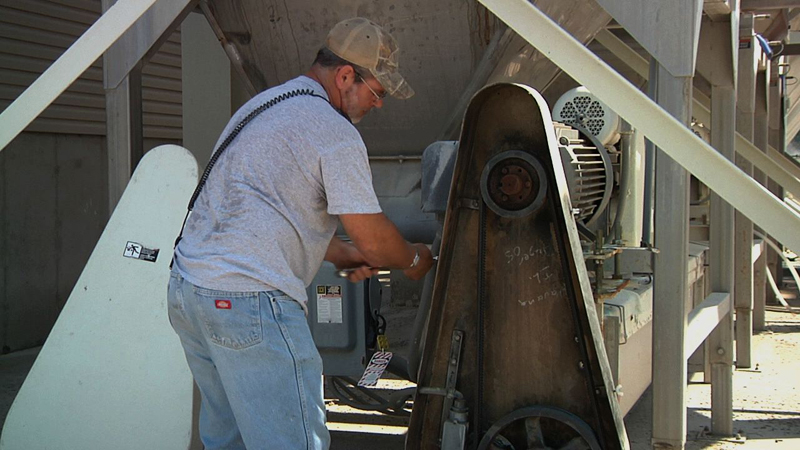
Lockout-tagout (LOTO) is a safety procedure used in industry and research settings to ensure that machinery and equipment are properly shut off and not restarted prior to the completion of maintenance or servicing work. The procedure requires that hazardous power sources be “isolated and rendered inoperative” before any repair procedure is started. “Lockout/Tagout” works in conjunction with a lock usually locking the device or the power source with the hasp, and placing it in such a position that no hazardous power sources can be turned on. The procedure requires a tag be affixed to the locked device indicating it should not be turned on.
Modern machinery can contain many hazards to workers, from things like electrical, mechanical, pneumatic or hydraulic sources. For example, a typical machine may contain hazards like hot fluids, moving presses, blades, propellers, electrical heaters, conveyor belts with pinch points, moving chains, ultraviolet light, etc.
Disconnecting or making the equipment safe involves the removal of all energy sources and is known as “isolation”. The steps necessary to isolate equipment are required to be documented in a written lockout/tagout procedure. The isolation procedure generally includes the following tasks:
- Identify the energy source(s)
- Isolate the energy source(s)
- Lock and Tag the energy source(s)
- Prove that the equipment isolation is effective
The locking and tagging of the isolation point lets others know not to de-isolate the device.
Written Program
 Employers must develop, document and use procedures to control potentially hazardous energy. The procedures are required to explain what employees must know and do to control hazardous energy effectively when they service or maintain machinery. If this information is the same for the various machines used at a workplace, then a single energy-control procedure may suffice. For example, similar machines (those using the same type and magnitude of energy) that have the same or similar types of control measures can be covered by a single procedure. Employers must develop separate energy-control procedures if their workplaces have more variable conditions, such as multiple energy sources, different power connections or different control sequences that workers must follow to shut down various pieces of machinery.
The energy-control procedures must outline the scope, purpose, authorization, rules and techniques employees will use to control hazardous energy sources, as well as the means that will be used to enforce compliance. These procedures must provide employees at least the following information:
- A statement on how to use the procedures;
- Specific procedural steps to shut down, isolate, block and secure machines;
- Specific steps designating the safe placement, removal and transfer of lockout/tagout devices and identifying who has responsibility for the lockout/tagout devices; and
- Specific requirements for testing machines to determine and verify the effectiveness of lockout devices, tagout devices and other energy-control measures.
Annual Review
OSHA’s standard establishes minimum performance requirements for controlling hazardous energy. As part of an energy-control program, employers must inspect their procedures periodically (at least annually) to ensure they are being followed and remain effective in preventing employee exposure to hazardous energy.
Training
 OSHA’s standard requires each employer train employees on their energy-control program, including the safe application, use and removal of energy controls. The employer must provide initial training before starting service and maintenance activities and must provide retraining as necessary. Training must ensure employees understand the purpose, function and restrictions of the energy-control program. Employers must provide training specific to the needs of “authorized,” “affected” and “other” employees.
In addition, the employer must certify training has been given to all employees covered by the standard. The certification must contain each employee’s name and dates of training.
Employers must provide retraining for all authorized and affected employees whenever there is a change in the following:
- Job assignments,
- Machinery or processes that present a new hazard, or
- Energy-control procedures.
Retraining is also necessary whenever a periodic inspection reveals, or an employer has reason to believe, shortcomings exist in an employee’s knowledge or use of the energy-control procedure.
Equipment Available
Whether lockout or tagout devices are used, they must be the only devices the employer uses in conjunction with energy-isolating devices to control hazardous energy. The employer must provide these devices and they must be singularly identified and not used for other purposes. In addition, they must have the following characteristics:
- Durable enough to withstand workplace conditions. Tagout devices must not deteriorate or become illegible even when used with corrosive components such as acid or alkali chemicals or in wet environments.
- Standardized according to color, shape or size. Tagout devices also must be standardized according to print and format. Tags must be legible and understandable by all employees.
- They must warn employees about the hazards if the machine is energized, and offer employeesclear instruction such as: “Do Not Start,” “Do Not Open,” “Do Not Close,” “Do Not Energize” or”Do Not Operate.”
- Substantial enough to minimize the likelihood of premature or accidental removal. Employeesshould be able to remove locks only by using excessive force with special tools such as boltcutters or other metal-cutting tools. Tag attachments must be non-reusable, self-locking andnon-releasable, with a minimum unlocking strength of 50 pounds. Tags must be attachable byhand, and the device for attaching the tag should be a one-piece nylon cable tie or its equivalent, so it can withstand all environments and conditions.
- Labeled to identify the specific employees authorized to apply and remove them.
Lockout device – A device that uses a positive means such as a lock, either key or combination type, to hold an energy-isolating device in the safe position and prevent the energizing of a machine or equipment. Included are blank flanges and bolted slip blinds.
Tagout device – A prominent warning device, such as a tag and means of attachment, which can be securely fastened to an energy-isolating device in accordance with an established procedure, to indicate the energy-isolating device and equipment being controlled may not be operated until the tagout device is removed.
Energy-isolating device – A mechanical device which physically prevents the transmission or release of energy, including, but not limited to the following: a manually operated electrical circuit breaker; a disconnect switch; a manually operated switch by which the conductors of a circuit can be disconnected from all ungrounded supply conductors, and in addition, no pole can be operated independently; a line valve; a block; and any similar device used to block or isolate energy. Push buttons, selector switches and other control circuit-type devices are not energy-isolating devices.