
Introduction
These standards set minimum requirements for the storage, handling and transfer of propane, butane and other LP-Gases. They address container specifications including relief venting, valves, piping and support structures, as well as covering installation, storage practices, transfer operations, ignition source control and training.
Hose Specifications
Hose must be designed for a working pressure of 350 psi and must be continuously marked with “LP- GAS, PROPANE, 350 PSI WORKING PRESSURE” and with the manufacturer’s name or trademark. Hose must not show signs of excessive wear, worn spots, cuts, abrasions, blisters, bulges, soft spots, loose outer covering, wire-braid reinforcement exposed, kinks or flattened spots.
Relief Valves
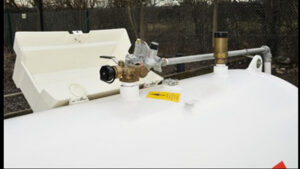 Containers of LP-Gas must be equipped with direct spring-loaded pressure relief valves conforming to the requirements of UL 132. Each pressure relief valve must be plainly and permanently marked with the pressure in psi at which the valve is set to start-to-break, rated relieving capacity in cubic feet per minute of air and the manufacturer’s name and catalog number.
On a container having a water capacity greater than 125 gallons, but not over 2,000 gallons, the discharge from the safety relief valves must be vented away from the container vertically upwards and unobstructed to the open air in such a manner as to prevent any impingement of escaping gas upon the container. Loose-fitting rain caps must be used.
Damage from Vehicles
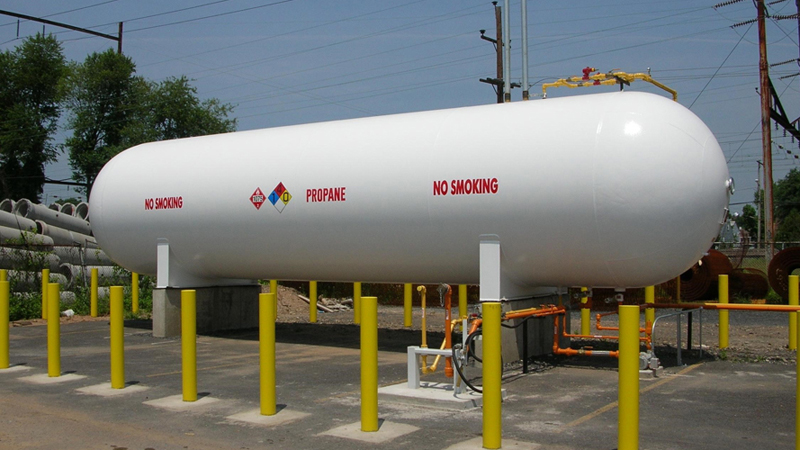
When damage to LP-Gas systems from vehicular traffic is a possibility, precautions against such damage must be taken
Competent Attendant
The dispensing of LP-Gas into the fuel container of a vehicle must be performed by a competent attendant who must remain at the LP-Gas dispenser during the entire transfer operation. This is not required where propane is used for heating only.
“Liquefied petroleum gases”, “LPG” and “LP-Gas” – any material which is composed predominantly of any of the following hydrocarbons, or mixtures of them; propane, propylene, butanes (normal butane or iso-butane) and butylenes.