Overview
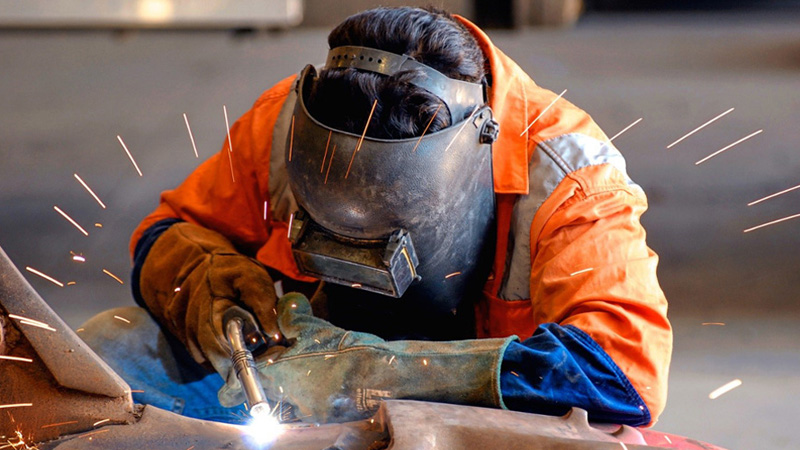
The American Society of Mechanical Engineers (ASME) Boiler and Pressure Vessel Code (BPVC) establishes rules of safety governing the design, fabrication andinspection of boilers and pressure vessels. Anhydrous ammonia is not considered a flammable gas. Nevertheless, welding on ammonia containers is not permitted, except by certified welders holding a R-stamp. The R-stamp is issued by the National Board.
A R-stamp welder is not required for piping fabrication/repair involving welding, even when the piping is connected to the ammonia storage vessel. However, the welder for the piping connected to an ammonia storage vessel must be certified in accordance with the ASME B&PV Code, Section IX. Section IX is invoked by the Process Piping Code, ASME 31.3.
ANSI K61.1-5.2.4 – Repair or alteration of pressure-containing parts of a container must be performed in compliance with the applicable provisions of the current edition of the National Board Inspection Code (NBIC). Where specific procedures are not given, it is intended that subject to acceptance of the inspector, all repairs or alterations must conform as much as possible to the ASME Code section and edition to which the container was constructed.
As practical guidance, the NBIC has many provisions that must be met. Among these:
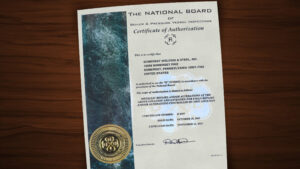
- The firm that completes any repair to a pressure vessel must hold a valid certificate of authorization to use the copyright-protected repair symbol of the National Board, commonly referred to as a R-stamp. The R-stamp may authorize repairs to be made at the repair firm or a field location, or both. The prospective repair firm must be able to display a valid certificate of authorization upon request;
- A R-stamp firm is required to hold a valid contract with an Authorized Inspection Agency;
- The authorized inspector has several duties, including oversight of the repair firm’s quality manual and oversight of the repair. The repair firm may only complete repairs or alterations within the scope of its quality manual, as approved by the authorized inspector. Ultimately for the repair or alteration, in order to qualify as a NBIC repair, the authorized inspector must complete the section titled “authorized inspection” on either the form R-1: Report of Repair or the form R-2: Report of Alteration; and
-
Prior to starting fabrication of piping, Contractors should supply to facility personnel all welding procedure specifications (WPS) and procedure qualification record (PQR) for review. Each individual welder should be certified in each process that they will be performing. All WPS’s and PQR’s should conform to the latest edition of ASME BPVC Sec. IX – Qualification Standard for Welding, Brazing and Fusing Procedures, as well as the latest edition of ASME B31.3 – Process Piping. All piping should be examined per the requirements listed in Sec. 341.4.1 of the latest edition of the ASME B31.3 Process Piping code.
- Visual Inspection of 5% of fabrication with each welder’s work included.
- Spot radiography or ultrasonic of 5% of circumferential butt or miter groove welds. Leak testing of all piping should be per the requirements listed in Sec. 345 of the latest edition of the ASME B31.3 Process Piping code.
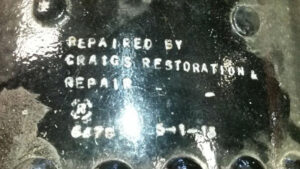
- Shop fabricated piping may be pneumatically tested with air or nitrogen to a pressure of 1.1 times the specified design pressure of the system for a minimum of 60 minutes.The R-stamp firm must apply the appropriate repair tag to the pressure vessel that displays the copyright-protected repair symbol of the National Board and stamp it with the R-stamp firm’s name, R-certificate number, date of repair and other information as required by the NBIC. Employers must keep any Manufacturer’s Partial Data Reports, as well as any Report of Repair or Report of Alteration forms on file.