Overview
The Department of Transportation (DOT) sets requirements for coupling devices and towing methods. Every towed vehicle must be connected to the towing vehicle by a safety device to prevent the towed vehicle from breaking loose in the event the tow-bar fails or becomes disconnected. When safety chains or cables are used as the safety device for that vehicle, at least two safety chains or cables must be used. The tensile strength of the safety device and the means of attachment to thevehicles must be at least equivalent to the required longitudinal strength for tow-bars. If safety chains or cables are used as the safety device, the required strength must be the combined strength of the combination of chains and cables.
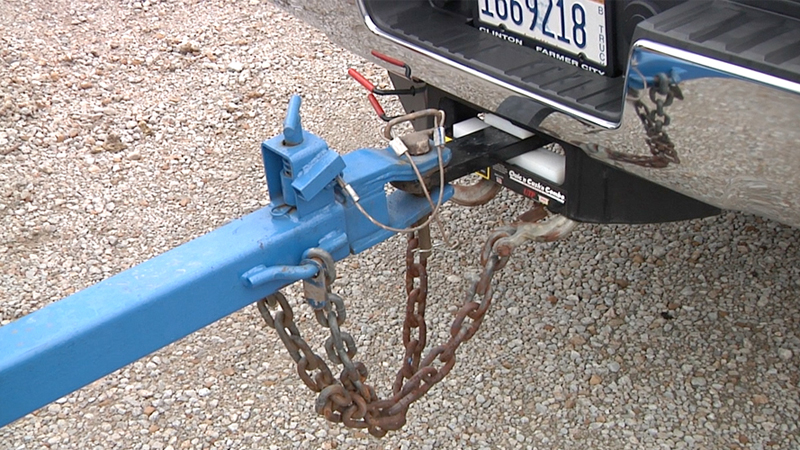
If chains or cables are used as the safety device, they must be crossed and attached to the vehicles near the points of bumper attachments to the chassis of the vehicles. The length of chain used must not be more than necessary to permit free turning of the vehicles. The chains must be attached to the tow-bar at the point of crossing or as close to that point as is practicable.
A safety device other than safety chains or cables must provide strength, security of attachment and directional stability equal to, or greater than, that provided by safety chains or cables. A safety device other than safety chains or cables must be designed, constructed and installed so that if the tow-bar fails or becomes disconnected, the tow-bar will not drop to the ground.
Chain Selection
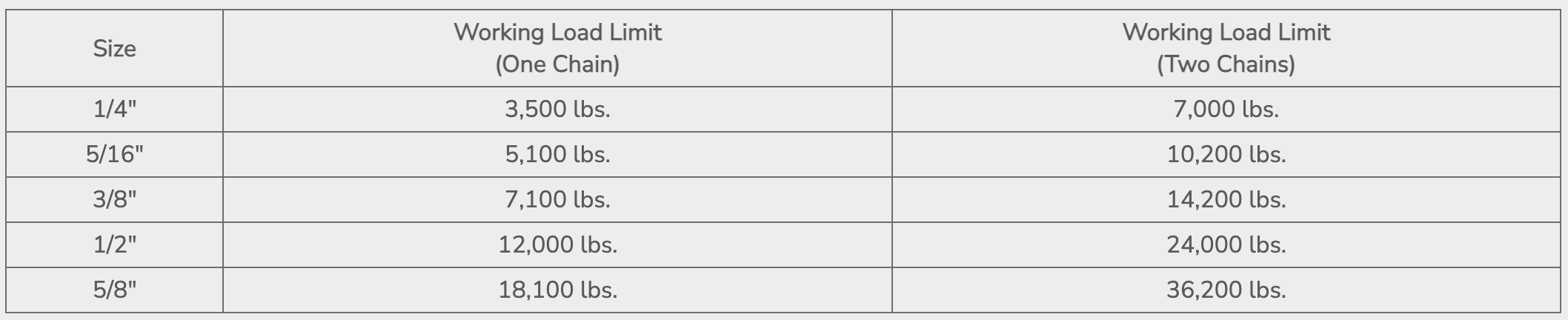
The Commercial Vehicle Safety Alliance (CVSA) has issued cargo securement tie-down guidelines. The following charts should aid in selecting the correct grade and size of chain:
GRADE 3 CHAIN (Proof Coil)
Identification Markings – PC, 3, 30
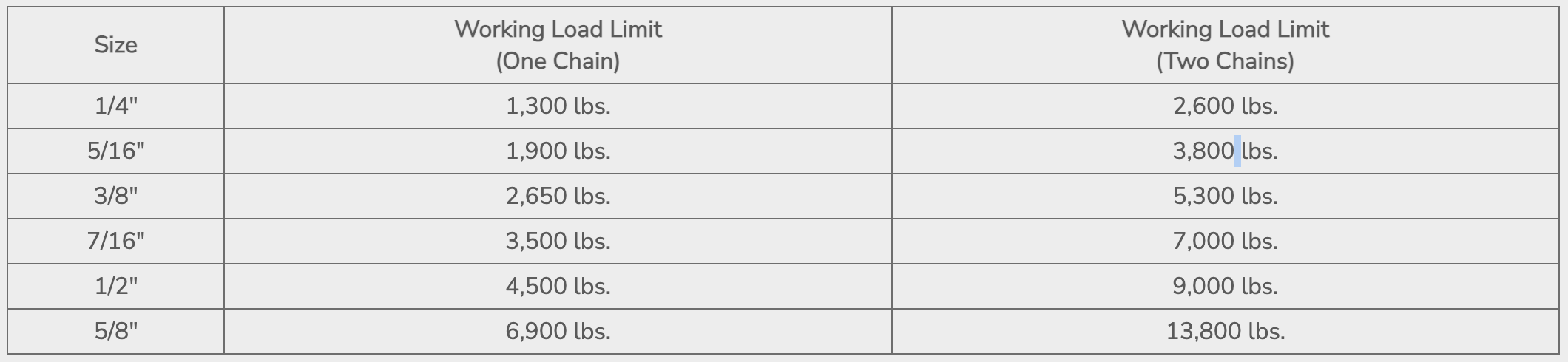
GRADE 4 CHAIN (High Test)
Identification Markings – HT, PH, M, 4, 43, 430
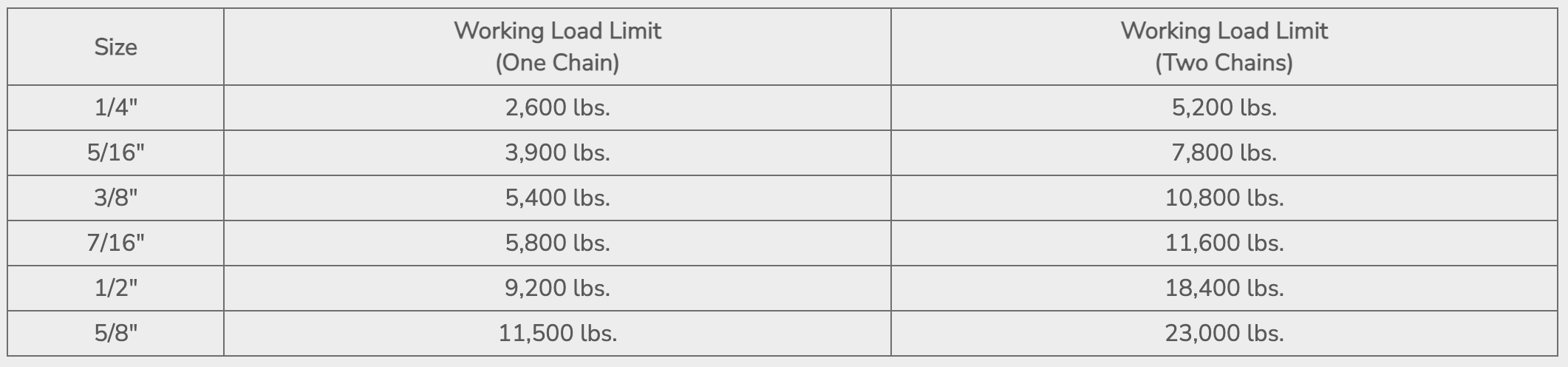
GRADE 7 CHAIN (Transport)
Identification Markings – 7, 70, 700
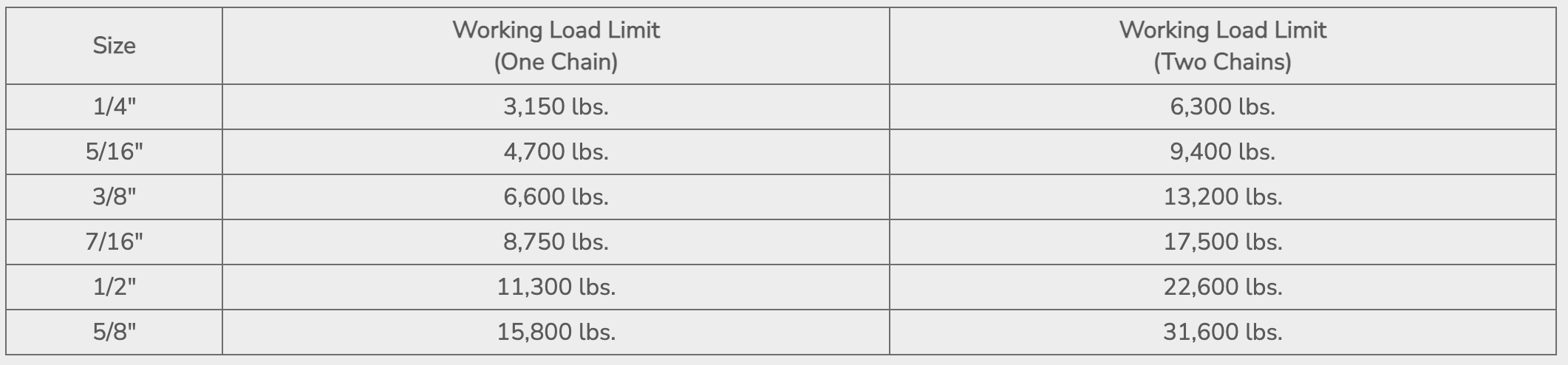
GRADE 8 CHAIN (Alloy)
Identification Markings – A, T, 8, 80, 800