
Introduction
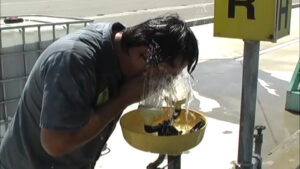
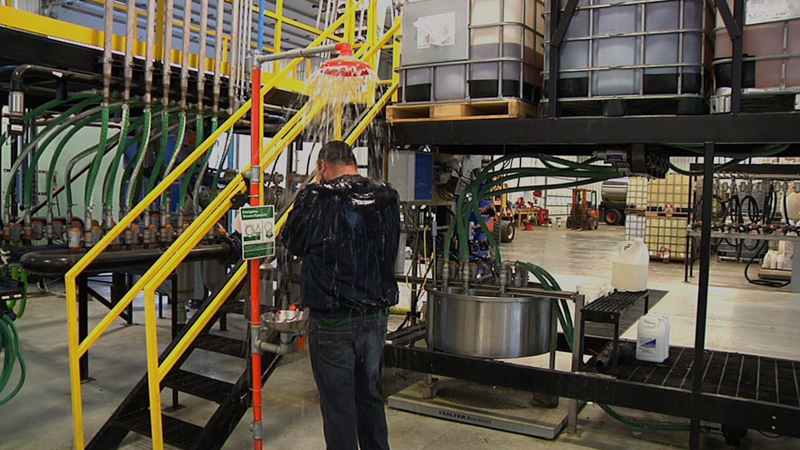
Employees that need to work around corrosive materials have a risk of getting them on their body or in their eyes. Personal Protective Equipment is issued to combat this risk, but if it is breached, the employee needs to remove as much of the substance as possible as quickly as possible. This makes having an emergency eyewash and shower equipment crucial.
– Where the eyes or body of any person may be exposed to injurious corrosive materials, suitable facilities for quick drenching or flushing of the eyes and body must be provided within the work area for immediate emergency use.
ANSI Z358.1 provides detailed information regarding the installation and operation of emergency eyewash and shower equipment.
Location
Water Temperature
The water temperature delivered by emergency equipment should be tepid with a range of 60 degrees – 100 degrees Fahrenheit. However, where it is possible that a chemical reaction might be accelerated by warm water, a medical professional should be consulted to determine what the optimum water temperature would be.
Training
All employees who may be exposed to hazardous, particulate or corrosive materials must be instructed on the proper operation of eyewash and shower equipment. In addition, all employees must be made aware of the locations of flushing stations.
Identification
Emergency eyewash and shower equipment must be installed in a well-lit area and identified with a highly visible safety sign.
Maintenance And Testing
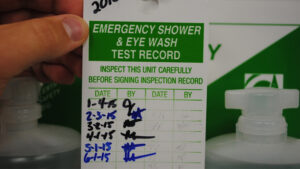 Proper maintenance and weekly testing are necessary to ensure that emergency eyewash and shower units are functioning safely and properly. Weekly testing helps clear the supply lines of sediment and bacteria build-up that is caused from stagnant water. Plumbed flushing equipment must be activated weekly for a period long enough to verify operation and ensure that flushing fluid is available. Portable and self-contained equipment must be visually checked to determine if the flushing fluid needs to be changed or supplemented.