
Overview
The Emergency Planning and Community Right-to-Know Act (EPCRA) requires information on the presence of hazardous chemicals above designated threshold quantities at regulated facilities be provided to state and local emergency planning authorities. This information facilitates the development of emergency response plans required by section 303 of EPCRA, enhances community awareness of chemical hazards and helps first responders to respond to chemical accidents. The chemicals covered under these requirements are a specific list of chemicals known as Extremely Hazardous Substances (EHS) found at 40 CFR Part 355 Appendices A and B and any chemicals that meet the criteria as hazardous chemicals under OSHA’s Hazard Communication Standard.
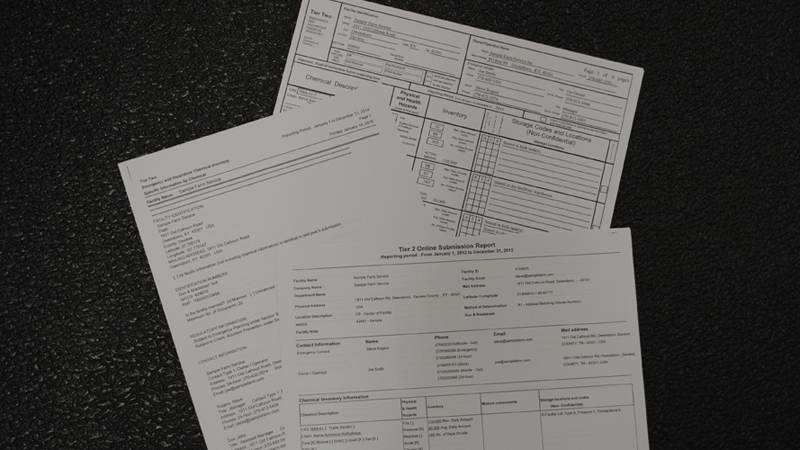
Section 311 of EPCRA requires employers to submit Safety Data Sheets (SDS) for the EHS and hazardous chemicals to their State or Tribal Emergency Response Commission (SERC or TERC), Local Emergency Planning Committee (LEPC) and local fire department. Section 312 requires employers to submit annually to their SERC or TERC, LEPC and local fire department, Hazardous Chemical Inventory forms for these chemicals. This is commonly called a SARA Tier II report. The SDS provides the chemical’s hazard information and emergency response guidelines. The Hazardous Chemical Inventory form provides the quantity, storage types and locations of the chemical at their facility.
The requirements for SARA Tier II reporting apply to any employer that is required to prepare or have available a Safety Data Sheet for a hazardous chemical under the OSH Act of 1970. The minimum threshold for reporting for Extremely Hazardous Substances (EHS) is 500 pounds or the threshold planning quantity (TPQ), whichever is lower. The minimum threshold for reporting for all other hazardous chemicals is 10,000 pounds, except for gasoline and diesel fuel (all grades combined) held in tanks entirely underground by a retail gas station. States may have lower reporting thresholds and additional chemicals covered by the state right-to-know regulations.
Section 311(e) of EPCRA excludes the following substances:
- Any food, food additive, color additive, drug or cosmetic regulated by the Food and Drug Administration;
- Any substance present as a solid in any manufactured item to the extent exposure to the substance does not occur under normal conditions of use;
- Any substance to the extent it is used for personal, family or household puposes, or is present in the same form and concentration as a product packaged for distribution and use by the general public;
- Any substance to the extent it is used in a research laboratory or a hospital or other medical facility under the direct supervision of a technically qualified individual; and
- Any substance to the extent it is used in routine agricultural operations or is a fertilizer held for sale by a retailer to the ultimate customer. NOTE: EPA does classify any agricultural retailer that blends fertilizer as a manufacturer for reporting purposes under Section 312 of EPCRA. Any agricultural retailer that blends (i.e. nonchemical reaction) dry fertilizer at their facility should include these products on a Tier II report.
Employers must prepare and file annual reports with the SERC or TERC, LEPC and the affected fire department, on or before March 1st each year, covering all hazardous chemicals present at a location at any one time during the preceding calendar year, at or over the thresholds. Many states now require a Tier II inventory form or the state equivalent, including electronic reporting under state law. The information submitted under sections 311 and 312 is available to the public from LEPCs and SERCs or TERCs.