
Overview
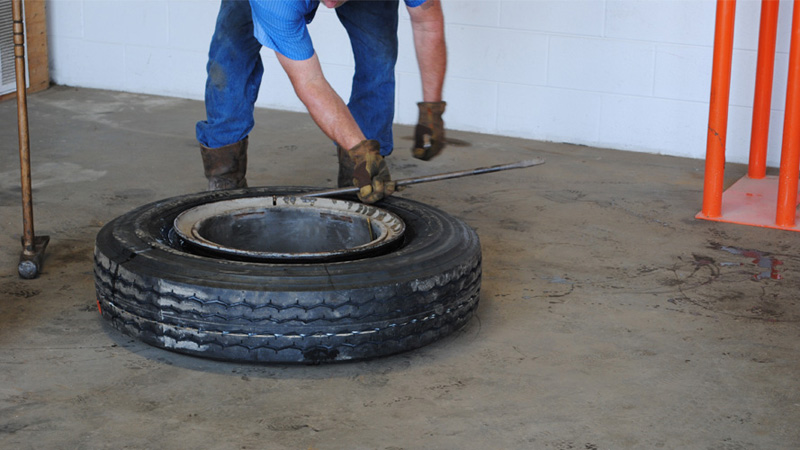
This Occupational Safety and Health Administration (OSHA) standard applies to the servicing of multi-piece and single piece rim wheels used on large vehicles such as trucks, tractors, trailers and off-road machines. It does not apply to the servicing of rim wheels used on automobiles, or on pickup trucks and vans utilizing automobile tires or truck tires designated “LT.”
Tire Servicing Equipment

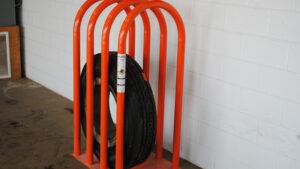
The employer must furnish a restraining device for inflating tires on multi-piece wheels. The employer must provide a restraining device or barrier for inflating tires on single piece wheels unless the rim wheel will be bolted onto a vehicle during inflation. Restraining devices and barriers must comply with the following requirements:
- Each restraining device or barrier must have the capacity to withstand the maximum force that would be transferred to it during a rim wheel separationoccurring at 150 percent of the maximum tire specification pressure for the type of rim wheel being serviced.
- Restraining devices and barriers must be capable of preventing the rim wheel components from being thrown outside or beyond the device or barrier for any rim wheel positioned within or behind the device.
- Restraining devices and barriers must be visually inspected prior to each day’s use and after any separation of the rim wheel components or sudden release of contained air. Any restraining device or barrier exhibiting damage such as cracks at welds, cracked or broken components, bent or sprung components, pitting of components due to corrosion or other structural damage which would decrease its effectiveness, must be immediately removed from service.
- Restraining devices or barriers removed from service must not be returned to service until they are repaired and reinspected. Restraining devices or barriers requiring structural repair, such as component replacement or rewelding, must not be returned to service until they are certified by either the manufacturer or a Registered Professional Engineer as meeting the strength requirements.
The employer must furnish and assure that an air line assembly consisting of the following components be used for inflating tires:
- A clip-on chuck;
- An in-line valve with a pressure gauge or a presettable regulator; and
- A sufficient length of hose between the clip-on chuck and the in-line valve (if one is used) to allow the employee to stand outside the trajectory.
Current charts or rim manuals containing instructions for the type of wheels being serviced must be available in the service area. The employer must provide a chart containing as a minimum the instructions and information provided in the US DOT, National Highway Traffic Safety Administration (NHTSA) publication “Safety Precautions for Mounting and Demounting Tube-Type Truck/Bus Tires” and “Multi-Piece Rim Wheel Matching Chart” and pertinent to the type(s) of multi-piece rim wheels being serviced. These charts may be in manual or poster form. OSHA also will accept any other manual or poster that provides at least the same instructions, safety precautions and other information contained in these publications, which is applicable to the types of wheels the employer is servicing. The employer must furnish and assure that only tools recommended in the rim manual for the type of wheel being serviced are used to service rim wheels.
Multi-Piece Rim Wheels
The employer must establish a safe operating procedure for servicing multi-piece rim wheels and must assure that employees are instructed in and follow that procedure. The procedure must include at least the following elements:
- Tires must be completely deflated before demounting by removal of the valve core.
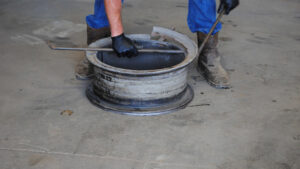
- Tires must be completely deflated by removing the valve core before a rim wheel is removed from the axle if the tire has been driven underinflated at 80% or less of its recommended pressure, or there is obvious or suspected damage to the tire or wheel components.
- Rubber lubricant must be applied to bead and rim mating surfaces during assembly of the wheel and inflation of the tire, unless the tire or wheel manufacturer recommends against it.
- If a tire on a vehicle is underinflated but has more than 80% of the recommended pressure, the tire may be inflated while the rim wheel is on the vehicle, provided remote control inflation equipment is used and no employees remain in the trajectory during inflation.
- Tires must be inflated outside a restraining device, only to a pressure sufficient to force the tire bead onto the rim ledge and create an airtight seal with the tire and bead.
- Whenever a rim wheel is in a restraining device, the employee must not rest or lean any part of his body or equipment on or against the restraining device.
- After tire inflation, the tire and wheel components must be inspected while still within the restraining device to make sure that they are properly seated and locked. If further adjustment to the tire or wheel components is necessary, the tire must be deflated by removal of the valve core before the adjustment is made.
- An attempt to correct the seating of side and lock rings by hammering, striking or forcing the components while the tire is pressurized must not be made.
- Cracked, broken, bent or otherwise damaged rim components must not be reworked, welded, brazed or otherwise heated.
- Whenever multi-piece rim wheels are being handled, employees must stay out of the trajectory unless the employer can demonstrate that performance of the servicing makes the employee’s presence in the trajectory necessary.
- No heat can be applied to a multi-piece wheel or wheel component
Single Piece Rim Wheels
The employer must establish a safe operating procedure for servicing single piece rim wheels and must assure that employees are instructed in and follow that procedure. The procedure must include at least the following elements:
- Tires must be completely deflated by removal of the valve core before demounting.
- Mounting and demounting of the tire must be done only from the narrow ledge side of the wheel. Care shall be taken to avoid damaging the tire beads while mounting tires on wheels. Tires must be mounted only on compatible wheels of matching bead diameter and width.
- Nonflammable rubber lubricant must be applied to bead and wheel mating surfaces before assembly of the rim wheel, unless the tire or wheel manufacturer recommends against the use of any rubber lubricant.
- If a tire changing machine is used, the tire must be inflated only to the minimum pressure necessary to force the tire bead onto the rim ledge while on the tire changing machine.
- If a bead expander is used, it must be removed before the valve core is installed and as soon as the rim wheel becomes airtight (the tire bead slips onto the bead seat).
- Tires may be inflated only when contained within a restraining device, positioned behind a barrier or bolted on the vehicle with the lug nuts fully tightened.
- Tires must not be inflated when any flat, solid surface is in the trajectory and within one foot of the sidewall.
- Employees must stay out of the trajectory when inflating a tire.
- Tires must not be inflated to more than the inflation pressure stamped in the sidewall unless a higher pressure is recommended by the manufacturer.
- Tires must not be inflated above the maximum pressure recommended by the manufacturer to seat the tire bead firmly against the rim flange.
- No heat can be applied to a single piece wheel.
- Cracked, broken, bent or otherwise damaged wheels must not be reworked, welded, brazed or otherwise heated.
Training
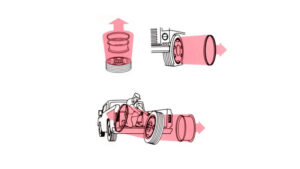
The employer must provide a program to train all employees who service rim wheels in the hazards involved and the safety procedures to be followed. The employer must assure that no employee services any rim wheel unless the worker has been instructed in correct procedures of mounting, demounting and service activities and the safe operating precautions for the type of wheel being serviced.
The employer must assure that each employee demonstrates and maintains the ability to service rim wheels safely, including performance of the following tasks:
- Demounting of tires (including deflation);
- Inspection and identification of the rim wheel components;
- Mounting of tires (including inflation with a restraining device or other safeguard required by this section);
- Use of the restraining device or barrier and other equipment;
- Handling of rim wheels;
- Inflation of the tire when a single piece rim wheel is mounted on a vehicle;
- An understanding of the necessity of standing outside the trajectory both during inflation of the tire and during inspection of the rim wheel following inflation; and
- Installation and removal of rim wheels.
The employer must evaluate each employee’s ability to perform these tasks and to service rim wheels safely, and must provide additional training as necessary to assure that each employee maintains his or her proficiency.