
Overview

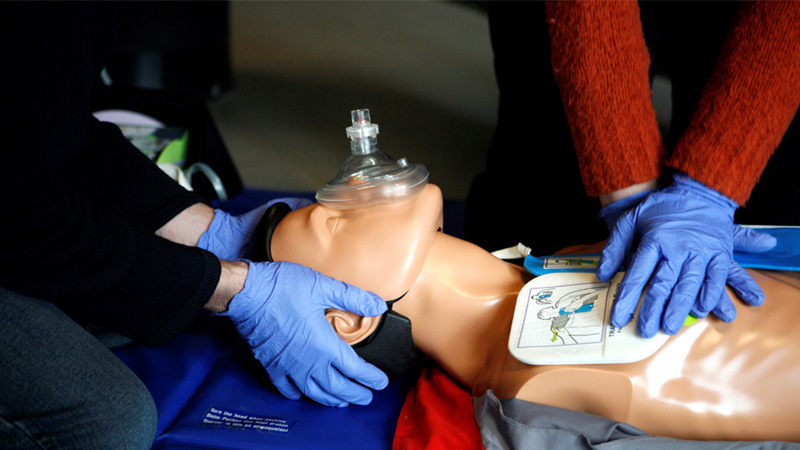
Cardiopulmonary Resuscitation (CPR) is an emergency procedure performed on people suffering cardiac arrest to provide a continuous flow of oxygen to the lungs and brain until the person regains consciousness. CPR is a combination of chest compressions and rescue breathing. This is typically performed rhythmically pressing on the person’s chest to manually pump blood through the heart and exhaling into the person’s mouth to inflate the lungs and pass oxygen into the blood. By performing CPR, the rescuer is increasing the chance for a full recovery. CPR alone is rarely enough for a person to survive but can sustain life until emergency medical personnel arrive to provide the next level of care.
An employer whose employees have been designated to provide permit space rescue and
emergency services must take the following measures:
- Provide affected employees with the personal protective equipment (PPE) needed to conduct permit space rescues safely and train affected employees so they are proficient in the use of that PPE, at no cost to those employees;
- Train affected employees to perform assigned rescue duties. The employer must ensure that such employees successfully complete the training required to establish proficiency as an authorized entrant;
- Train affected employees in basic first-aid and cardiopulmonary resuscitation (CPR). The employer must ensure that at least one member of the rescue team or service holding a current certification in first aid and CPR is available; and
- Ensure that affected employees practice making permit space rescues at least once every 12 months, by means of simulated rescue operations in which they remove dummies, mannequins or actual persons from the actual or representative permit spaces. Representative permit spaces must simulate the types of permit spaces from which rescue is to be performed.