
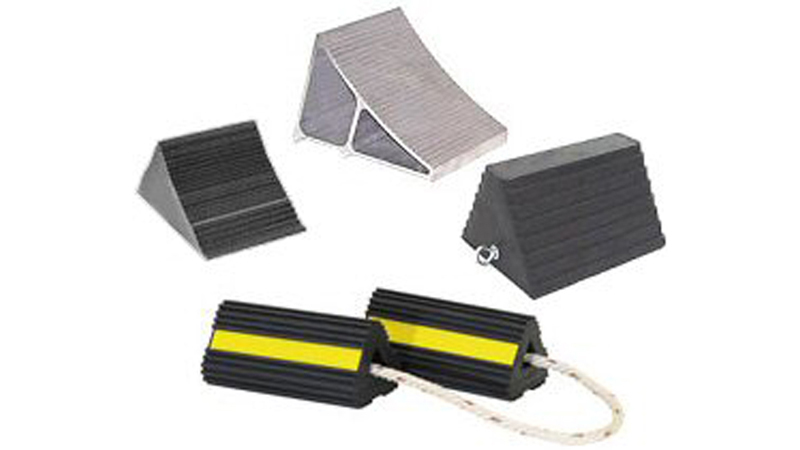
Overview
The Occupational Safety and Health Administration (OSHA), in several standards, requires the use of wheel chocks to prevent the rolling or moving of equipment to protect employees. Listed below are a few examples.
Trucks And Railroad Cars
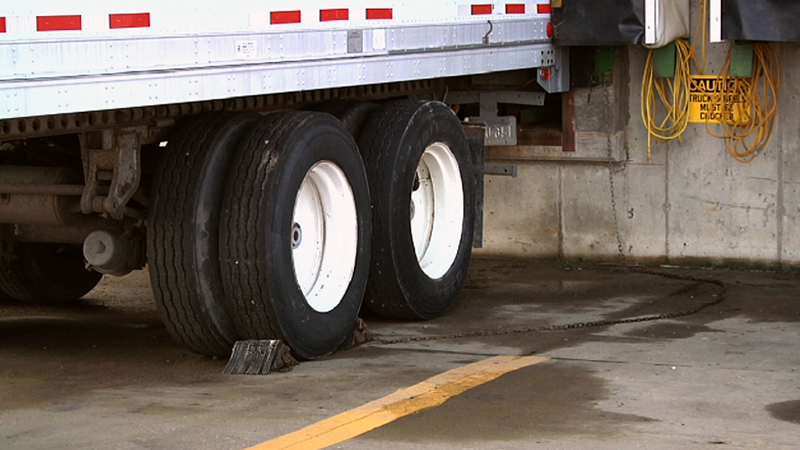
29 CFR 1910.178 – The brakes of highway trucks must be set and wheel chocks placed under the rear wheels to prevent the trucks from rolling while they are boarded with powered industrial trucks. Wheel stops or other recognized positive protection must be provided to prevent railroad cars from moving during loading or unloading operations. Brakes must be set and wheel blocks must be in place to prevent movement of trucks, trailers or railroad cars while loading or unloading. Fixed jacks may be necessary to support a semi-trailer during loading or unloading when the trailer is not coupled to a tractor.
Vehicles Transporting Anhydrous Ammonia
29 CFR 1910.111(f)(9) – For vehicles transporting anhydrous ammonia, at least two chock blocks must be provided. These blocks must be placed to prevent rolling of the vehicle whenever it is parked during loading and unloading operations. This includes nurse wagons and trucks.
LP-Gas Or Propane Trucks
NFPA 58 – For LP-Gas or propane trucks, the National Fire Protection Association requires each tank truck and trailer must carry chock blocks, which must be used to prevent rolling of the vehicle whenever it is being loaded, unloaded or is parked. Wheel chocks must also be placed to prevent movement of the railroad cars in either direction.