

Overview
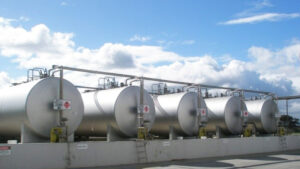
A Spill Prevention, Control and Countermeasure (SPCC) Plan is the document required by the Environmental Protection Agency (EPA) that details the equipment, workforce, procedures and steps to prevent, control and provide adequate countermeasures to foreseeably prevent a discharge of oil products. A SPCC Plan is required if the aggregate total aboveground storage capacity of oil products (Capacity of 55 gallons or more) is greater than 1,320 gallons. Oil of any type and in any form is covered, including, but not limited to: petroleum; fuel oil; sludge; oil refuse; oil mixed with wastes other than dredged spoil; fats, oils or greases of animal, fish, or marine mammal origin; vegetable oils, including oil from seeds, nuts, fruits, or kernels; and other oils and greases, including synthetic oils and mineral oils. The threshold includes non-petroleum oil products if they are found present in the United States Coast Guard’s “List of Petroleum and Non-Petroleum Oils.”
This regulation applies to facilities that can reasonably expect a discharge of oil that may be harmful to navigable waters or adjoining shorelines. This can be determined by considering the geography and location of the facility relative to nearby navigable waters (such as streams, creeks and other waterways). Additionally, it should be determined if ditches, gullies, storm sewers or other drainage systems might transport an oil spill to nearby streams. Precipitation runoff that could transport oil into navigable waters or adjoining shorelines should also be considered. Man-made features, such as dikes, equipment or other structures that might prevent, contain, hinder or restrain the flow of oil, cannot be taken into account.
Qualified Facilties
The rule provides simplified spill prevention requirements for qualified facilities. The owner or operator of a qualified facility can self-certify the facility’s SPCC Plan. There are two types of qualified facilities. For both types, the total aboveground oil storage capacity for the facility must be 10,000 gallons or less. Also, within three years prior to the Plan certification date, or since becoming subject to the SPCC rule if in operation for less than three years, the facility cannot have had the following:
- A single discharge of oil to navigable waters or adjoining shorelines exceeding 1,000 gallons; or
- Two discharges of oil to navigable waters or adjoining shorelines each exceeding 42 gallons within any 12-month period.
If the facility meets this criteria and has no individual aboveground oil containers greater than 5,000 gallons, they can complete and self-certify a SPCC Plan template in lieu of a full Professional Engineer (PE)-certified Plan or other self-certified SPCC Plan. This is a Tier 1 qualified facility. Tier 1 qualified facilities can choose to complete and certify the SPCC Plan template found in Appendix G of the SPCC rule.
If the facility meets these criteria and has any individual aboveground oil container greater than 5,000 gallons, they can prepare a self-certified SPCC Plan in lieu of a PE-certified Plan. This is a Tier 2 qualified facility. The requirements for a Tier 2 qualified facility are similar to a PE-certified Plan, however, the owner or operator certifies the Plan.
An owner or operator that certifies a facility’s SPCC Plan attests that they are familiar with the SPCC requirements and have visited and examined the facility. The owner or operator also certifies that:
- The Plan has been prepared in accordance with accepted and sound industry practices and standards and with the rule requirements;
- Procedures for required inspections and testing have been established;
- The Plan is being fully implemented;
- The facility meets the qualifying criteria;
- The Plan does not deviate from rule requirements, except as allowed and as certified by a PE; and
- Management approves the SPCC Plan and has committed resources to implement it.
Professionals Engineer(pe)-certified SPCC Plans
If a facility does not qualify as either a Tier 1 or Tier 2 qualified facility, then you must have the SPCC Plan certified by a Professional Engineer (PE). The facility owner or operator is responsible for preparation of the SPCC Plan, but it must be certified by a PE who will confirm that:
- The PE is familiar with the requirements of the rule;
- The PE or his agent has visited and examined the facility;
- The SPCC Plan has been prepared in accordance with good engineering practices, including consideration of applicable industry standards, and with the requirements of the rule;
- Procedures for required inspections and testing have been established; and
- The SPCC Plan is adequate for the facility.
General Requirements
Owners or operators of a facility must prepare a SPCC Plan in accordance with good engineering practices. The plan must be prepared in writing and have the full approval of management at a level of authority to commit the necessary resources to fully implement the plan. The plan must describe the physical layout of the facility and include a facility diagram, which must mark the location and contents of each fixed oil storage container and the storage area where mobile or portable containers are located.
The plan must also address: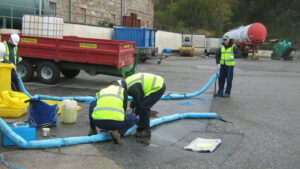
- The type of oil in each fixed container and its storage capacity. For mobile or portable containers, either provide the type of oil and storage capacity for each container or provide an estimate of the potential number of mobile or portable containers, the types of oil and anticipated storage capacities;
- Discharge prevention measures, including procedures for routine handling of products (loading, unloading and facility transfers, etc.);
- Discharge or drainage controls, such as secondary containment around containers and other structures, equipment and procedures for the control of a discharge;
- Countermeasures for discharge discovery, response and cleanup (both the facility’s capability and those that might be required of a contractor);
- Methods of disposal of recovered materials in accordance with applicable legal requirements; and
- Contact list and phone numbers for the facility response coordinator, National Response Center, cleanup contractors with whom you have an agreement for response and all appropriate Federal, State and local agencies who must be contacted in case of a discharge.